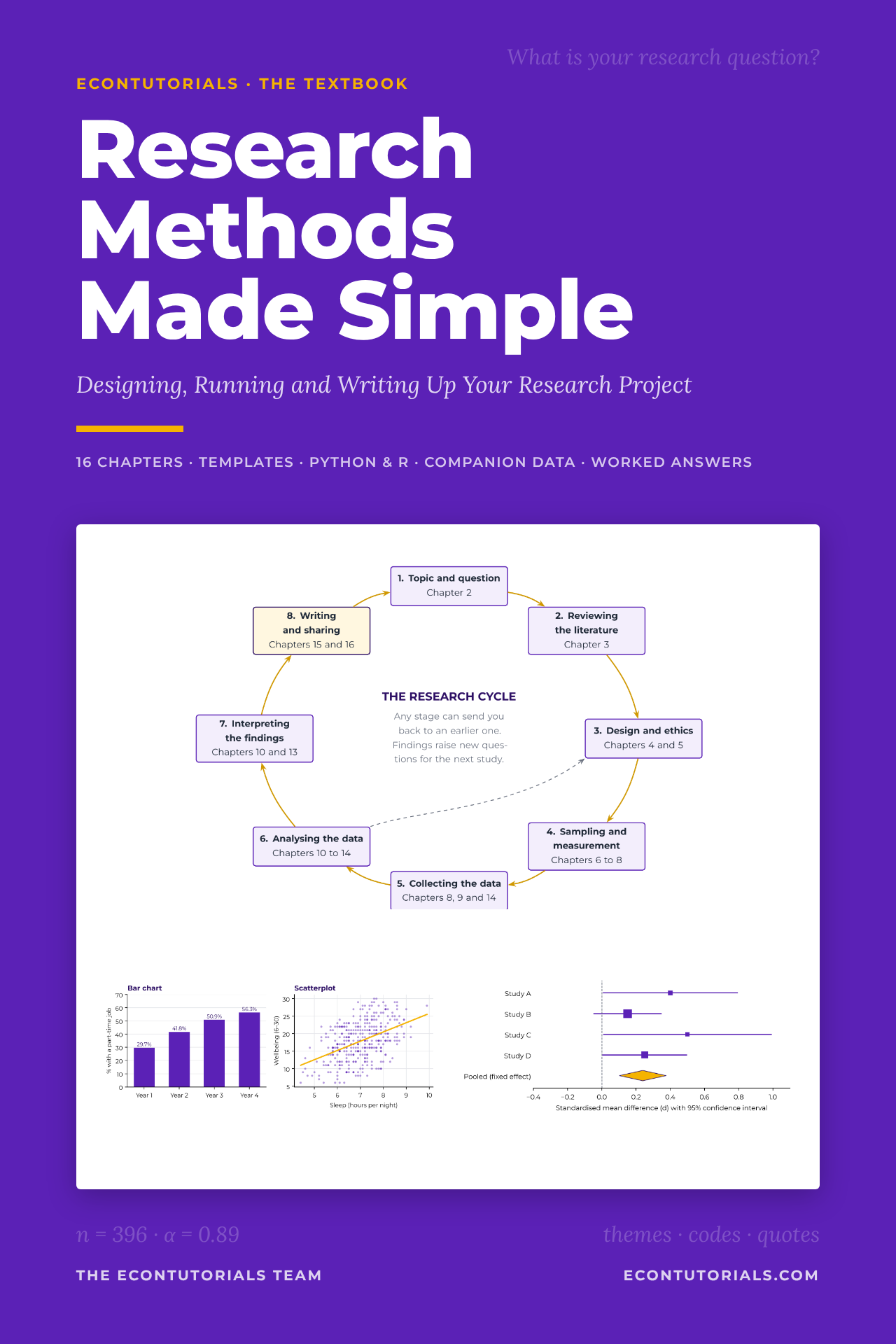
Description
Most students meet research methods twice: once in a module full of unfamiliar words, and again, alone, when the dissertation starts. This research methods textbook is written for the second moment. It explains each step of a real project, shows it done on a running example, and gives you the templates and checklists to do it yourself.
The whole book follows one companion study about students’ part-time jobs, so you see the same project move from a research question to a design, a questionnaire and interviews, the analysis and the write-up. The data are included, so you can repeat every analysis.
What this research methods textbook covers
- Part I — Starting a Research Project (Chapters 1–4). What research is and how it works; from topic to research question (FINER, PICO, aims and objectives, hypotheses); reviewing the literature (searching databases, Boolean strings, critical reading, synthesis); research ethics and integrity (informed consent, data protection, AI use and disclosure).
- Part II — Designing the Study (Chapters 5–8). Research design (experiments, quasi-experiments, case studies, causality and validity); sampling, sample size and weights; measurement, validity and reliability (Cronbach’s alpha); designing questionnaires and surveys.
- Part III — Collecting and Analysing Data (Chapters 9–14). Interviews, focus groups and observation; analysing qualitative data (coding, codebooks, thematic analysis); describing and visualising data; choosing and running statistical tests; regression and causal questions; secondary data, mixed methods and systematic reviews (PRISMA).
- Part IV — Writing It Up (Chapters 15–16). Writing the dissertation chapter by chapter; referencing (Harvard, APA 7, Chicago), presentations, posters and preparing for a viva or defence.
- Appendices. A: choosing the right statistical test (decision charts). B: templates. C: software guide (Excel, Python, R, SPSS, Stata, jamovi, coding interviews in a spreadsheet). D: a glossary of 176 terms.
Quantitative and qualitative, side by side
Many methods books lean one way. This one gives both equal care: the quantitative chapters run every analysis in Python and R with the real output printed, and the qualitative chapters work through ten interview transcripts, from first coding to a finished thematic analysis with quotes. Chapter 14 shows how to combine them in a mixed-methods study.
Built for your dissertation
Every chapter has learning objectives, key-term boxes, worked examples, common-error warnings, “In your dissertation” tips, templates and quick checks, then multiple-choice, short-answer, data and “apply it to your project” questions with full answers. Every number in the book was computed by software and checked automatically.
Who it is for
Undergraduate and master’s students in economics, business, education, psychology, health and the social sciences; IB Extended Essay and A-level NEA students; and anyone supervising them. For deeper statistics, see Statistics Made Simple and Econometrics Made Simple.
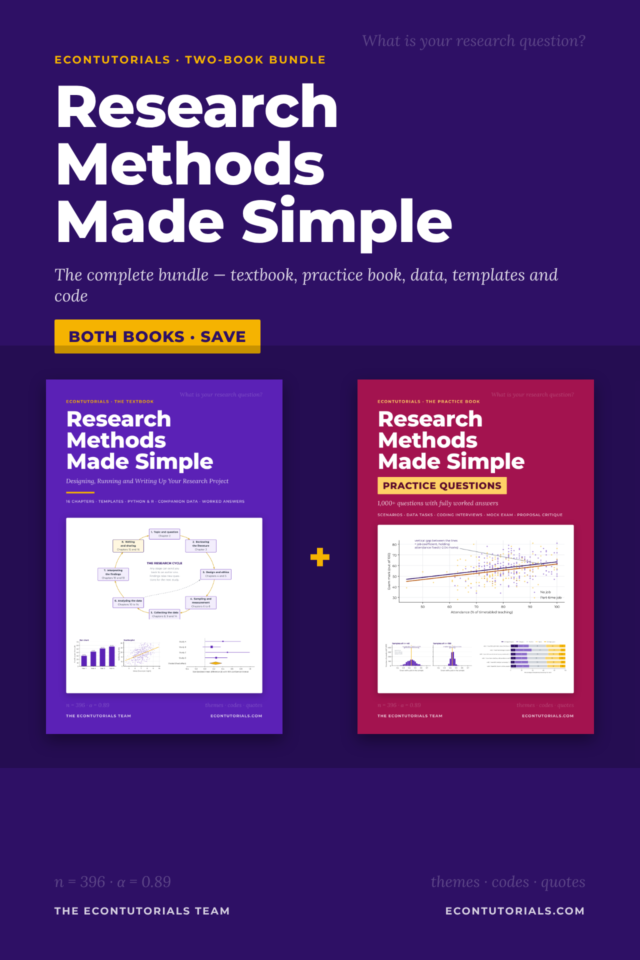
Practise with the Research Methods Made Simple Practice Questions (1,004 questions), or get both books in the Research Methods bundle for $19.
Instant download: the full PDF, each chapter as a separate PDF, and the data and code pack. Download a free sample chapter below before you buy.