Description
Real evidence for your development economics essays
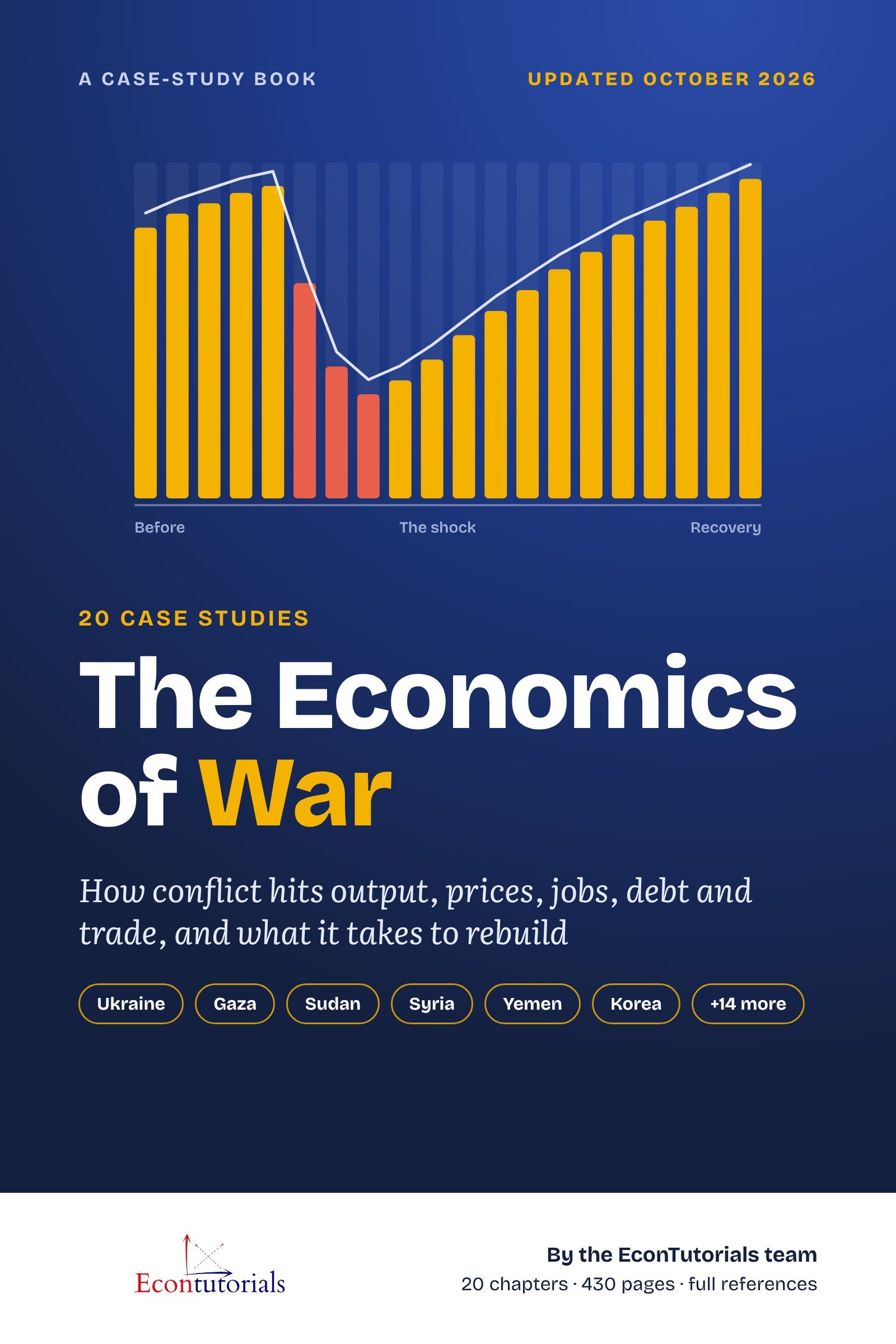
Examiners reward evaluation backed by real-world evidence. This book gives you 20 complete case studies of how conflict changes an economy, with the numbers, the timeline, the theory and the sources, all in one place.
Two framework chapters come first: how war hits an economy, and how governments pay for it through taxes, borrowing, money printing and aid. Eighteen country studies follow, and a final chapter draws the lessons together: what speeds recovery and what fails.
Every chapter follows the same plan
- How the war began, with a dated timeline, and where things stand as of October 2026
- The economy before the war
- The impact, indicator by indicator: GDP, inflation and the currency, public finances and debt, trade and key sectors, the labour market, poverty and human capital
- What went well and what went wrong
- The economics behind it: opportunity cost, AD/AS shocks, the PPC, sanctions, war finance, institutions
- Outlook and reconstruction costs
- Four exam-style questions with answer guides, a glossary and a full reference list
Contents
- How War Hits an Economy: A Framework and the Indicators to Watch
- Paying for War: Taxes, Borrowing, Money Printing and Aid
- Israel and Gaza, 2023–2026
- The Iran Wars of 2025–2026 and the Strait of Hormuz
- Russia and Ukraine, 2022 Onwards
- Sudan’s Civil War, 2023 Onwards
- Yemen and the Red Sea Shipping Crisis
- Lebanon, 2023–2026
- Myanmar Since the 2021 Coup
- Ethiopia’s Tigray War, 2020–2022
- Syria, 2011–2024, and the Economy After Assad
- Iraq Since 2003
- Afghanistan, 2001–2021, and After
- Kuwait and the 1990–91 Gulf War
- Bosnia and the Yugoslav Wars, 1992–95
- Rwanda: Recovery After the 1994 Genocide
- Germany and Japan After 1945
- The Korean War and the Great Divergence
- The Vietnam War and Đổi Mới
- Conclusions: What Speeds Recovery After War
Sources you can trust
Every figure carries a numbered reference to the IMF, the World Bank, UN agencies, central banks, national statistics offices, research institutes or major news organisations. Where sources disagree, both figures are shown. The book analyses economic effects and takes no side in any conflict.
You can read the chapters free on the website at Economics of conflict. The book gives you the complete, printable edition in one file.