Description
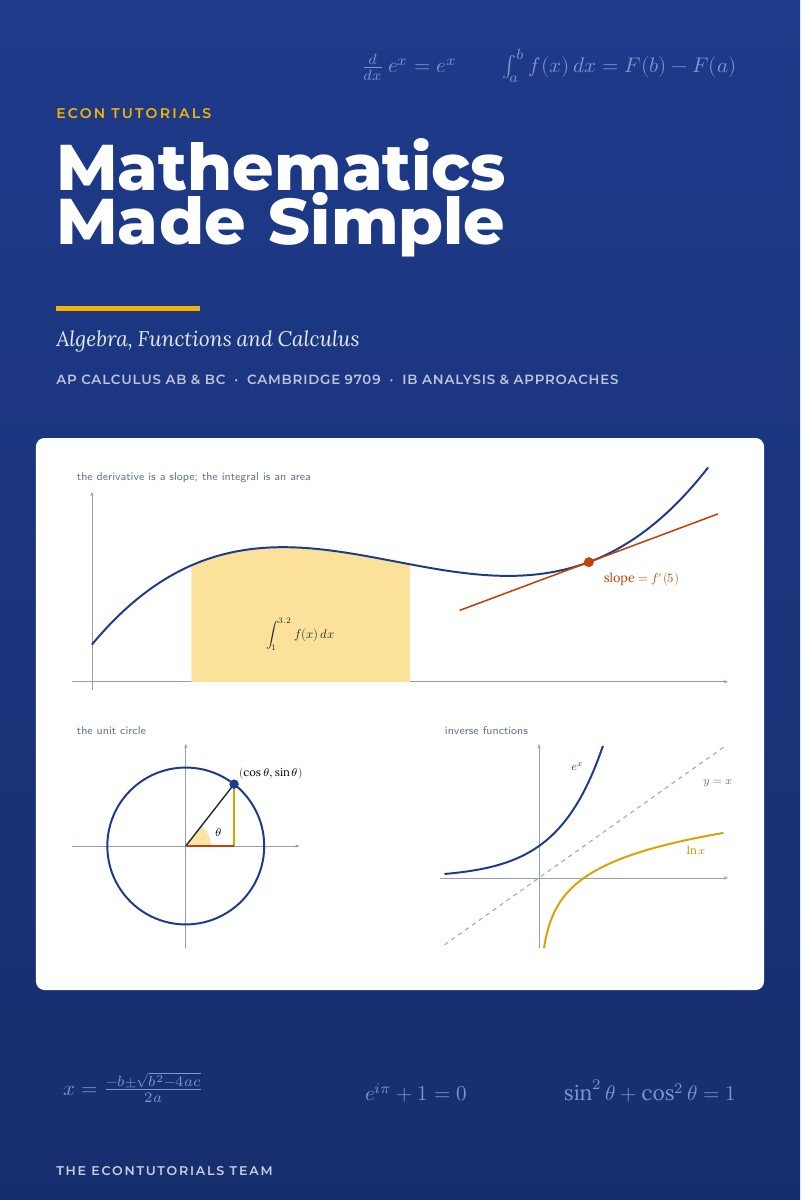
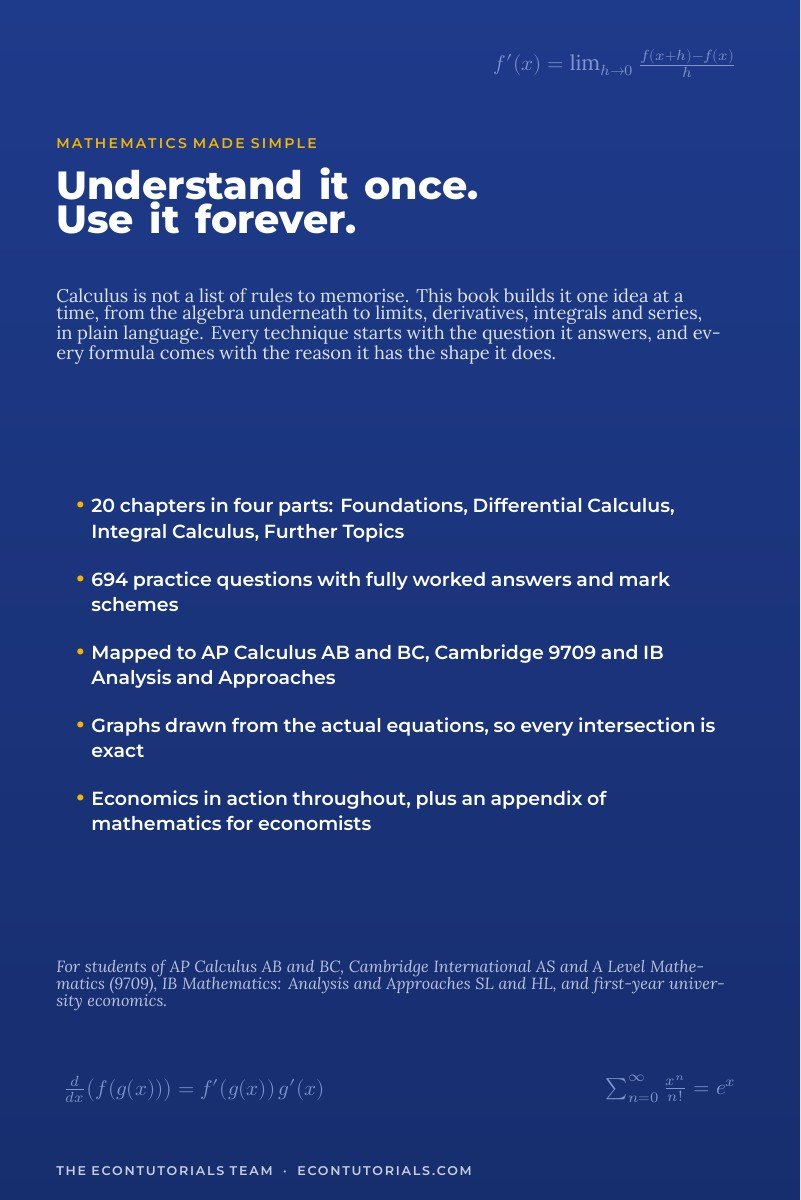
Most students who struggle with calculus are not struggling with calculus. They are struggling with the algebra underneath it, or with a rule they were told to memorise and never shown the reason for. This calculus textbook fixes both. It builds the subject one idea at a time, in plain language, and every technique opens with the question it answers before any formula appears.
Every formula also comes with a short Why this shape? explanation: why the chain rule multiplies, why an integral needs a +C, why radians make the derivative of sin x equal cos x. A formula you understand is one you can rebuild in an exam when memory fails.
What this calculus textbook covers
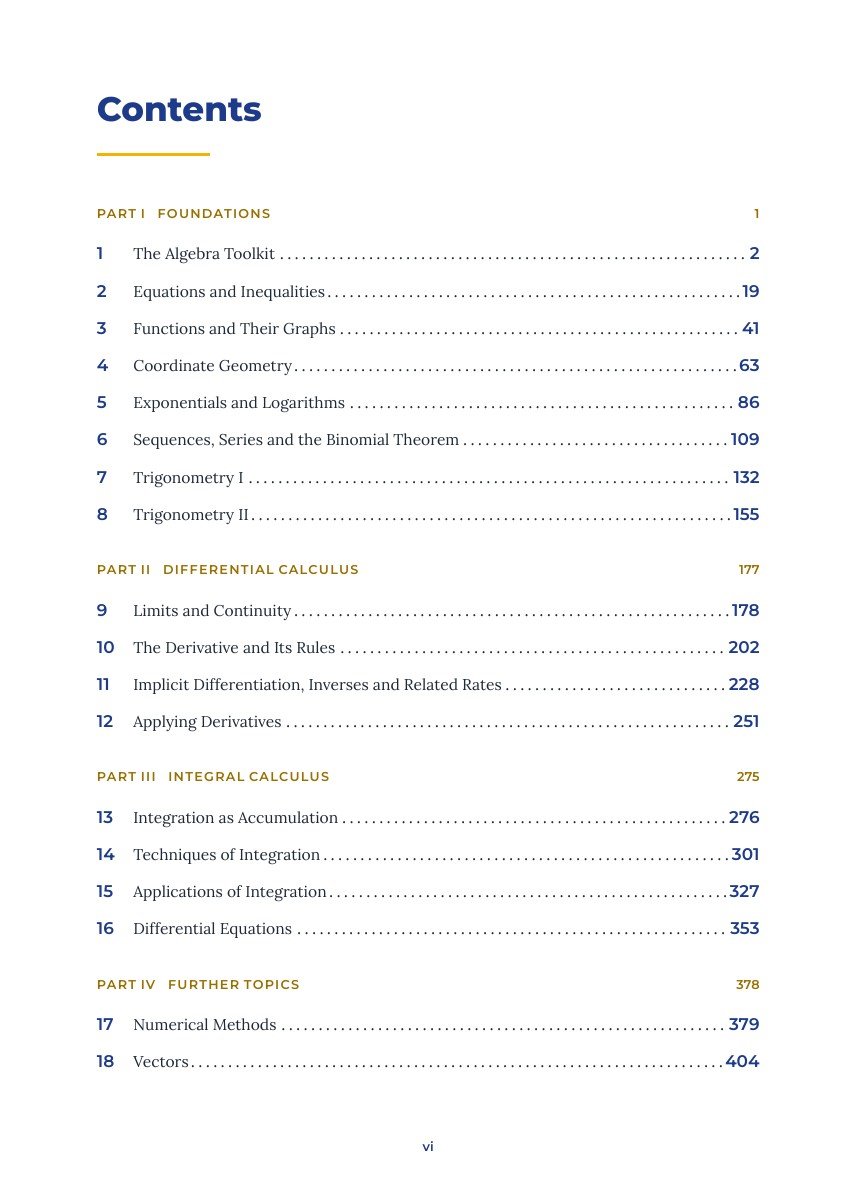
- Part I — Foundations (Chapters 1–8). Indices, surds and polynomials; quadratics, completing the square, the discriminant, inequalities and modulus; functions, composites, inverses and transformations; lines and circles; exponentials and logarithms; sequences, series and the binomial theorem; trigonometry, identities and the harmonic form.
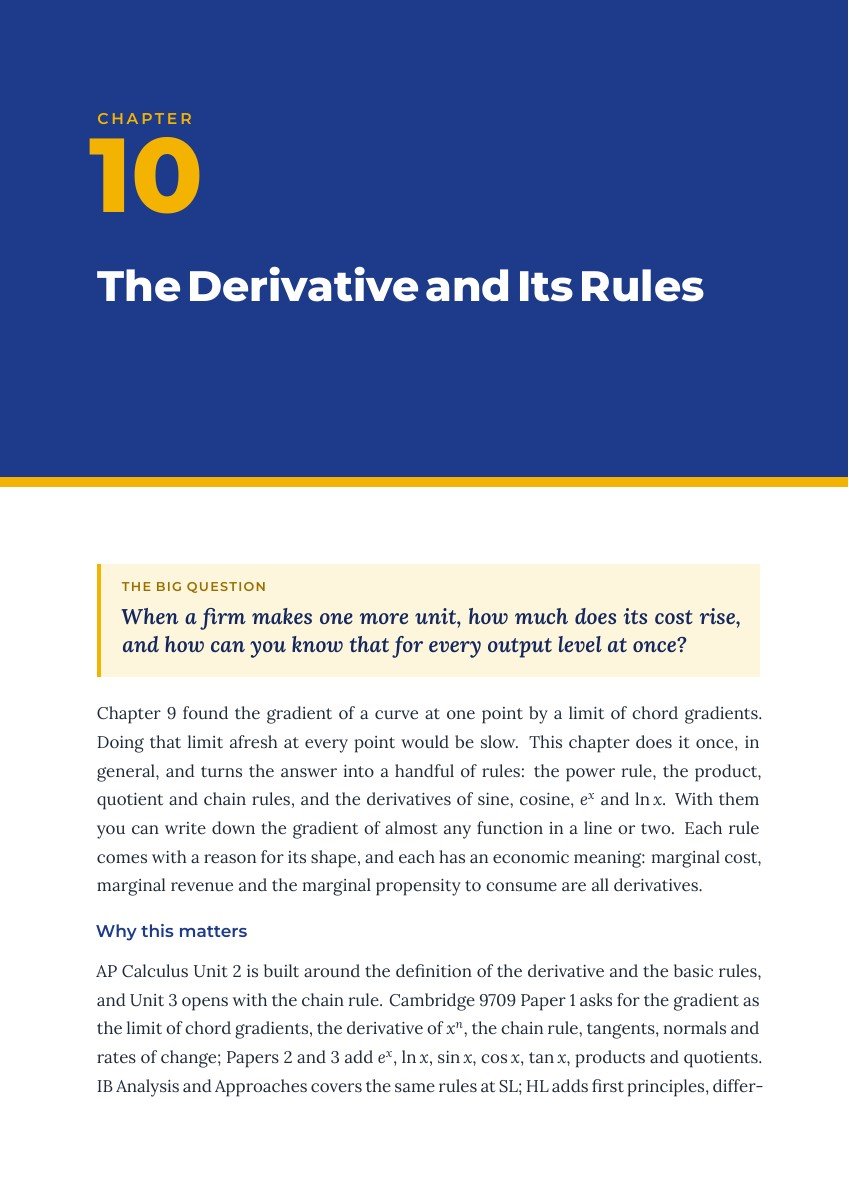
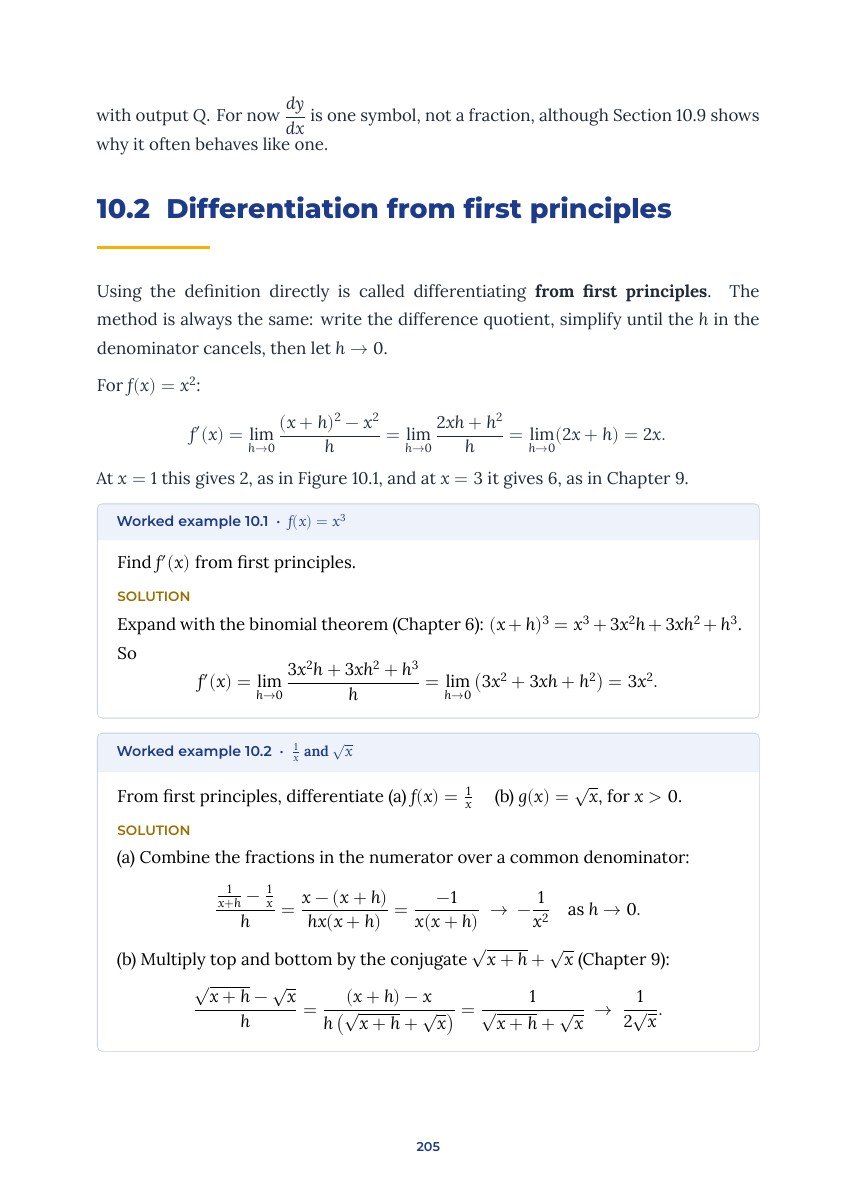
- Part II — Differential Calculus (Chapters 9–12). Limits and continuity; the derivative from first principles; power, product, quotient and chain rules; implicit, inverse and parametric differentiation; related rates; stationary points, concavity, optimisation, the Mean Value Theorem, L’Hôpital’s rule and motion.
- Part III — Integral Calculus (Chapters 13–16). Riemann sums and the trapezium rule; the Fundamental Theorem of Calculus; substitution, parts and partial fractions; improper integrals; areas, volumes of revolution, cross-sections and arc length; differential equations, slope fields, Euler’s method and logistic growth.
- Part IV — Further Topics (Chapters 17–20). Numerical methods and iteration; vectors and lines in 3D; complex numbers, loci and De Moivre’s theorem; parametric and polar curves; infinite series, convergence tests and Taylor and Maclaurin series.
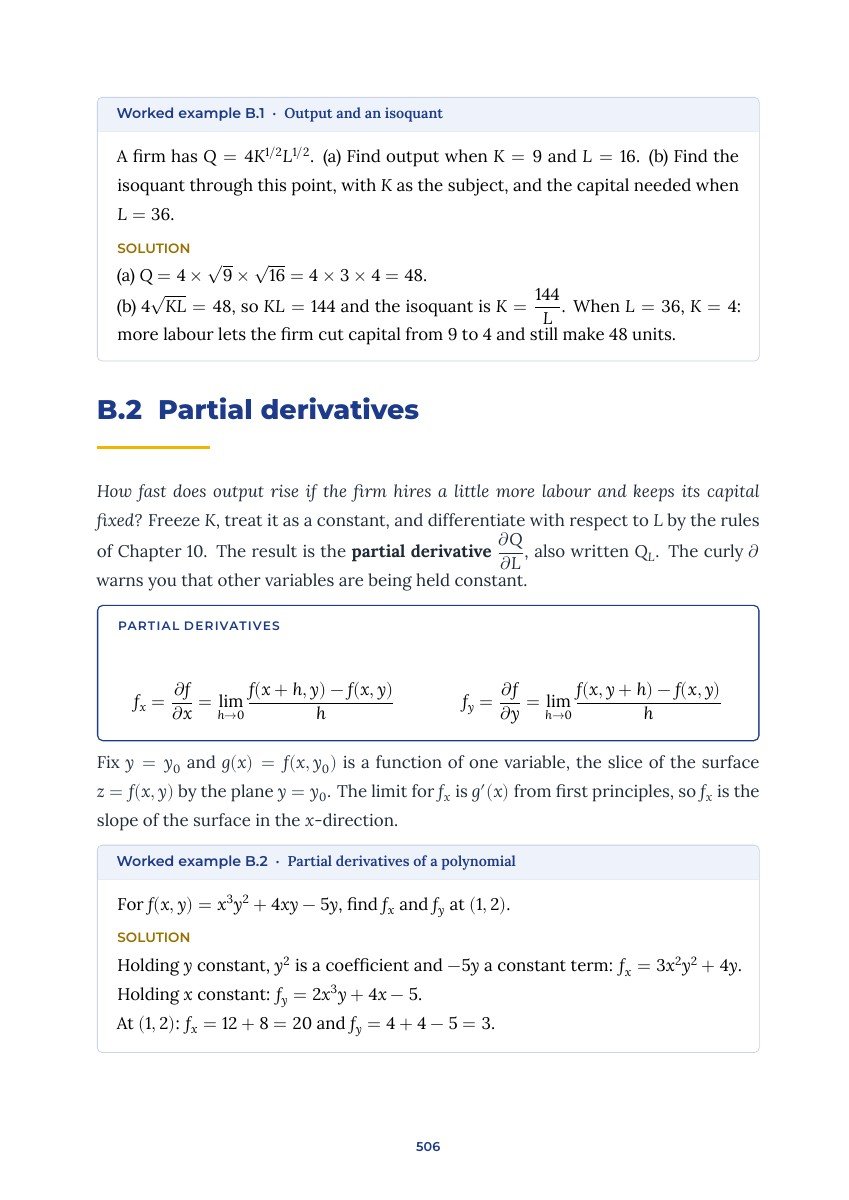
- Appendices. A: doing it with technology (graphing calculators, Desmos and Python, with every output verified). B: mathematics for economists (partial derivatives, Lagrange multipliers, matrices and the Leontief model). C: a complete formula sheet, chapter-referenced.
Built around your exam
Every learning objective is tagged with the syllabus that examines it, so you can skip what your exam does not need. The book follows the AP Calculus AB and BC course unit by unit, including the new May 2027 exam format; the topics of Cambridge International AS and A Level Mathematics (9709) Papers 1, 2 and 3; and IB Mathematics: Analysis and Approaches at SL and HL. A table at the front shows exactly which chapters each course needs.
How every chapter works
Each chapter opens with a big question and a real hook, then teaches the ideas through worked examples, Key Term boxes, Common Error boxes for the mistakes that cost marks, Exam Tips on how answers are marked, and Economics in action boxes that put the mathematics to work: compound interest, present value, marginal cost and revenue, profit maximisation, consumer surplus, the Gini coefficient and growth models.
Every chapter ends with 33 practice questions: 18 multiple choice, 10 short answer and 5 exam-style questions in AP, Cambridge and IB formats, with fully worked answers and M1/A1/B1 mark schemes.
Every answer checked by computer
Every numerical and algebraic answer in the book, from the worked examples to the last practice question, was checked by computer algebra before publication: over 2,500 individual checks. The explanations were also proofread independently by a separate reviewer.
Who this maths book is for
Written for students taking AP Calculus AB or BC, Cambridge A Level Mathematics, IB Mathematics: Analysis and Approaches, or a first-year university mathematics course for economics and business — and for anyone returning to calculus after time away. It is the companion to Economics Made Simple and Statistics Made Simple.
What you get
- The complete 539-page textbook as a PDF, bookmarked by part and chapter
- A Reader Pack with every chapter as a standalone PDF, the formula sheet on its own, and the Python code from Appendix A as ready-to-run files
Instant download after checkout. No account and no subscription required, and the files are yours to keep. Free updates if we correct anything.
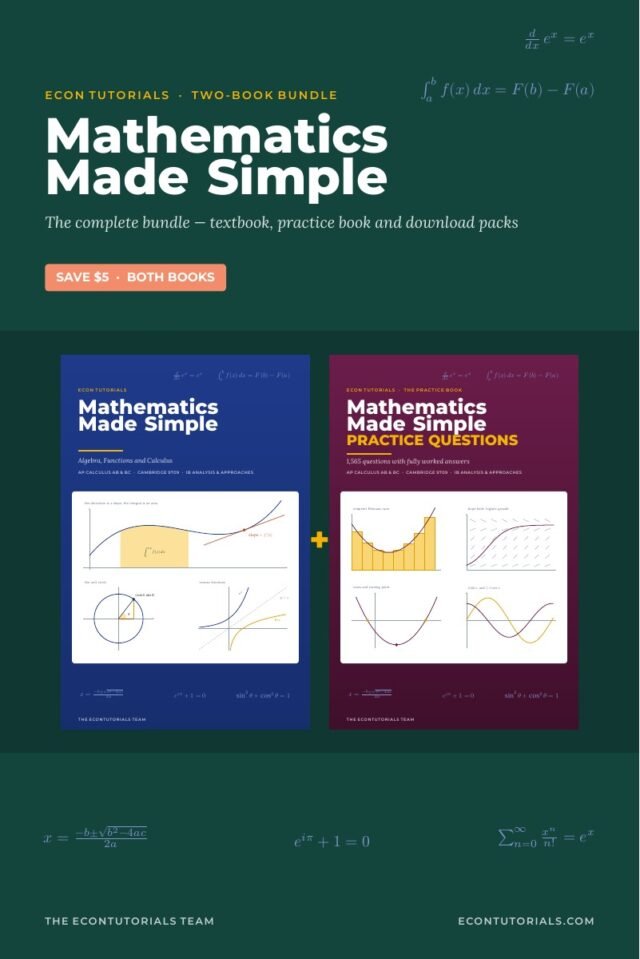
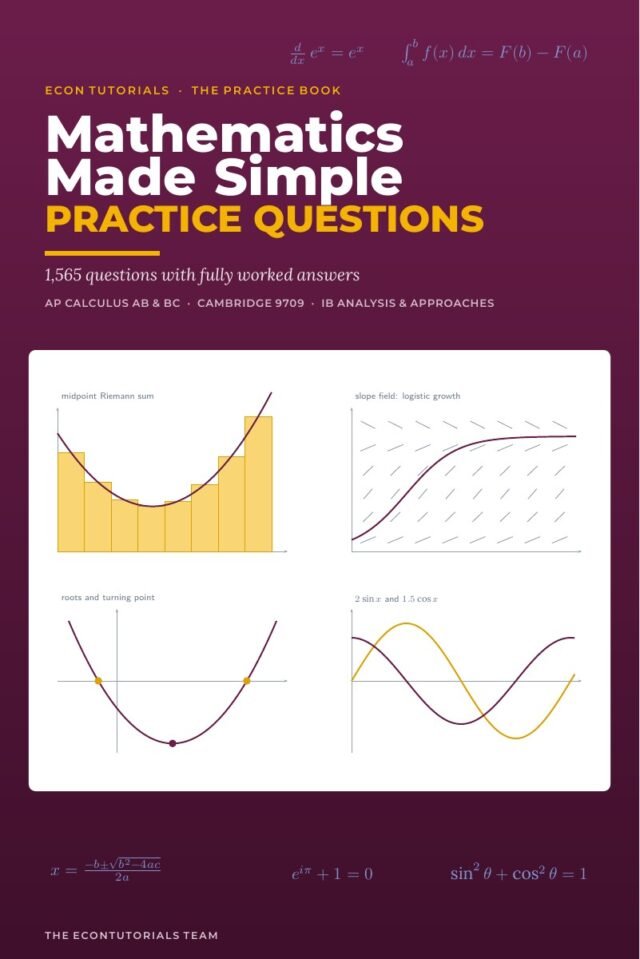
Want more practice? The companion practice book has 1,565 further questions with full worked solutions.