Description
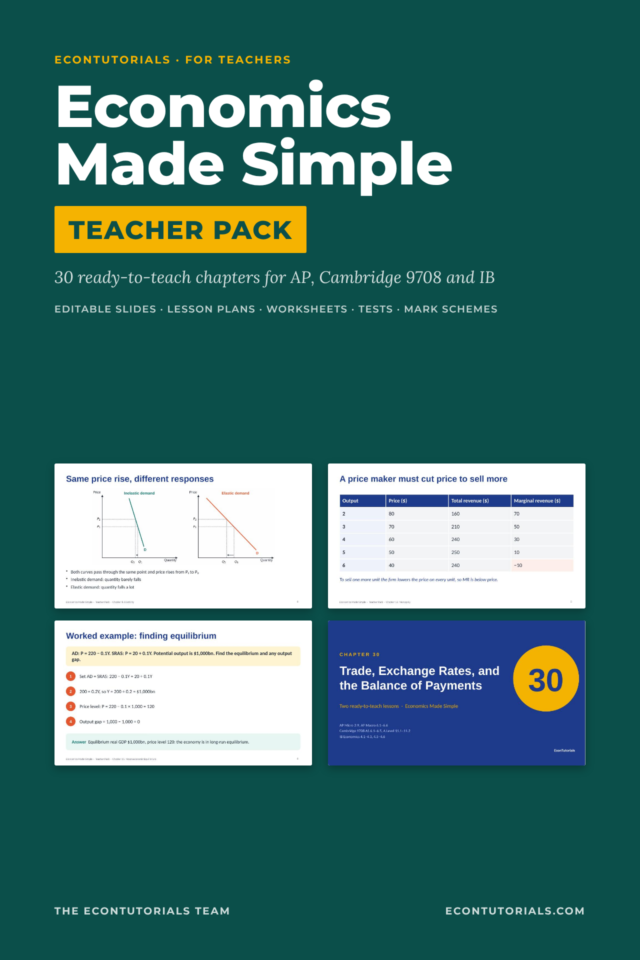
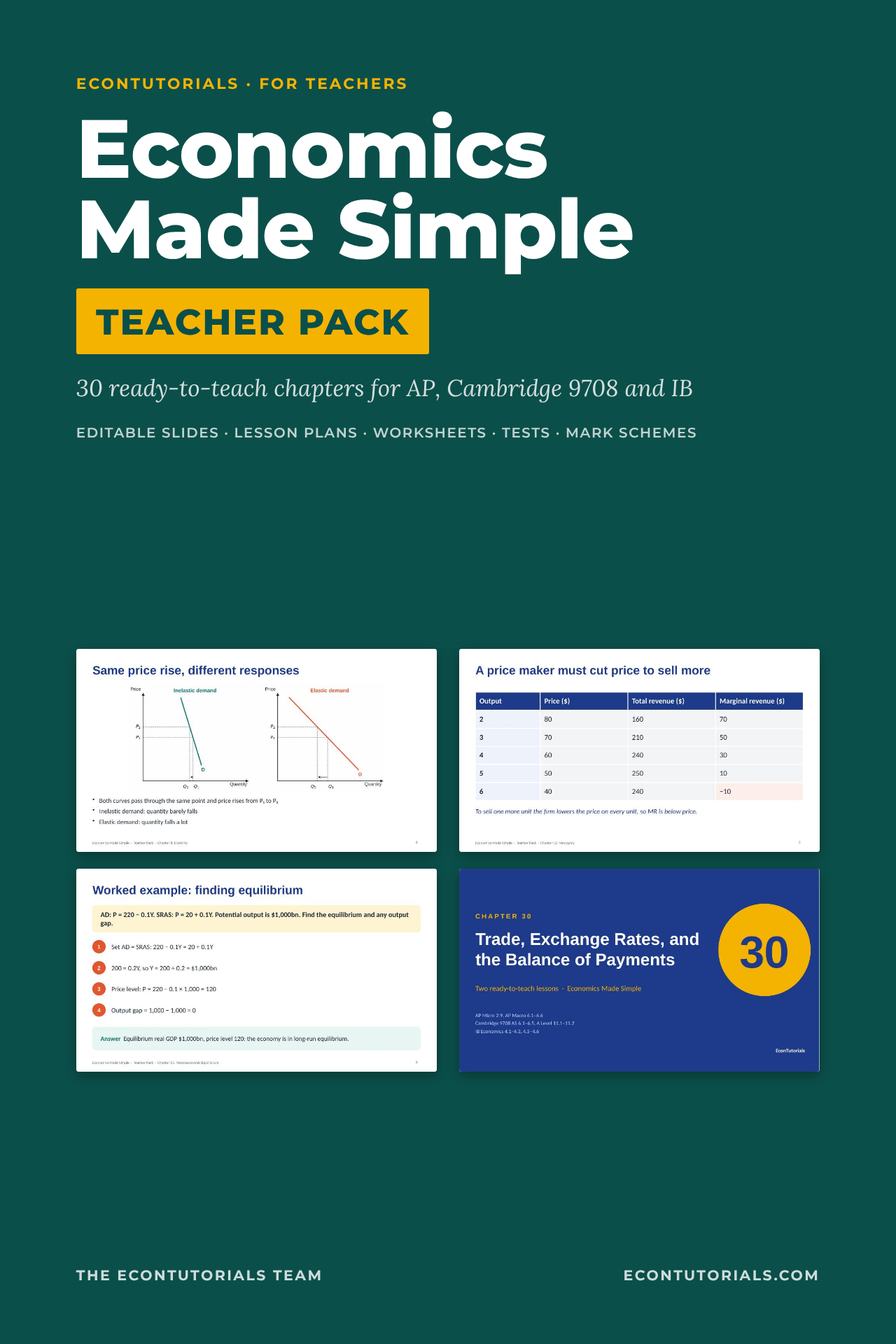
Planning a year of economics takes hundreds of hours: slides, worksheets, tests, mark schemes, diagrams that are actually accurate. This economics teacher pack does that work for you. It covers the whole course in 30 chapters, from scarcity and the production possibility curve to exchange rates and the balance of payments, and every chapter is ready to teach on Monday.
It follows the chapters of Economics Made Simple, so students can read the matching chapter at home, but it works perfectly well on its own with any textbook.
What is in every chapter folder
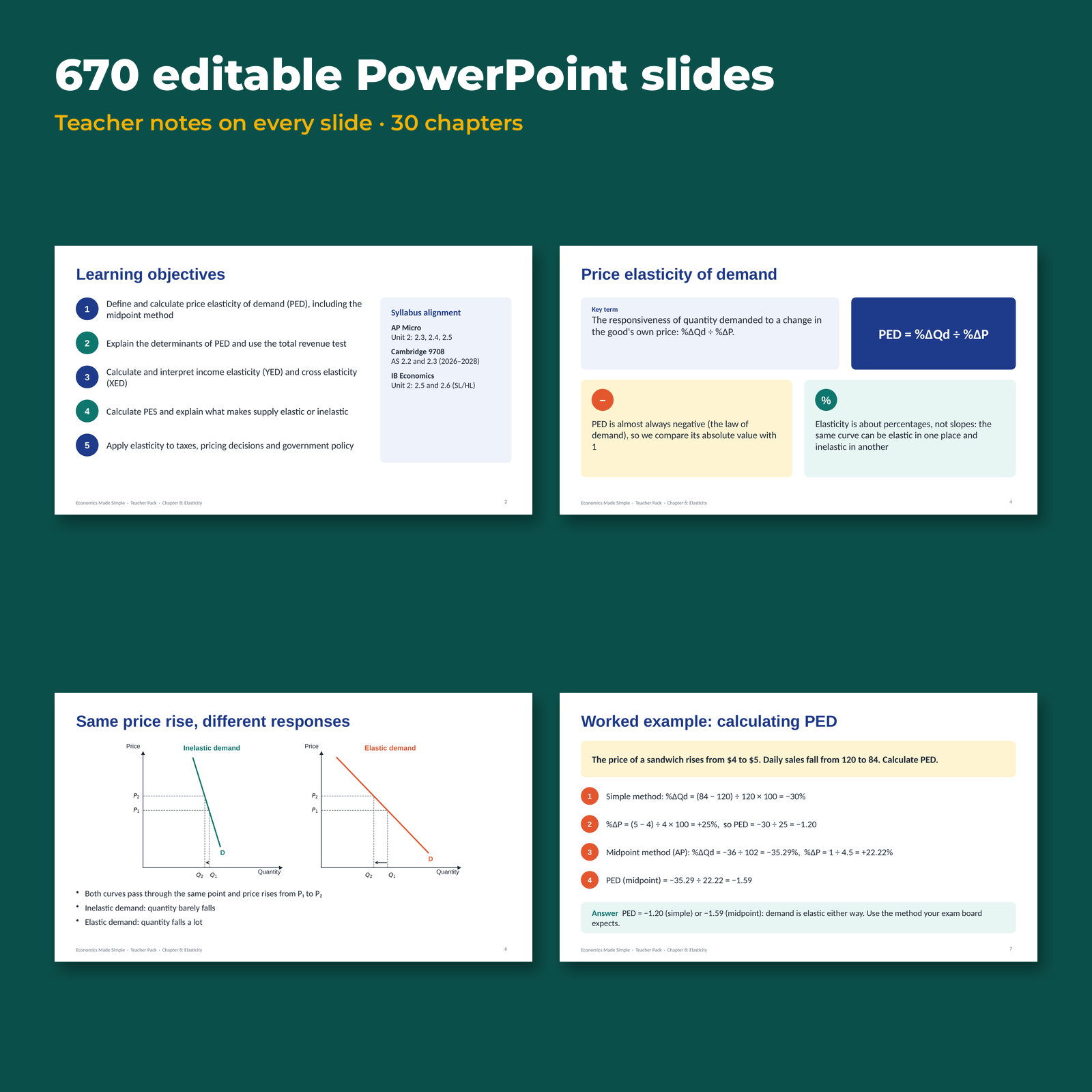
- Editable slides (.pptx) — 18 to 24 slides per chapter: starter, key terms, worked examples, diagrams, check-your-understanding questions, a real-world case study, an activity and exit questions. Every slide has teacher notes with the questions to ask, the misconceptions to watch for and the answers.
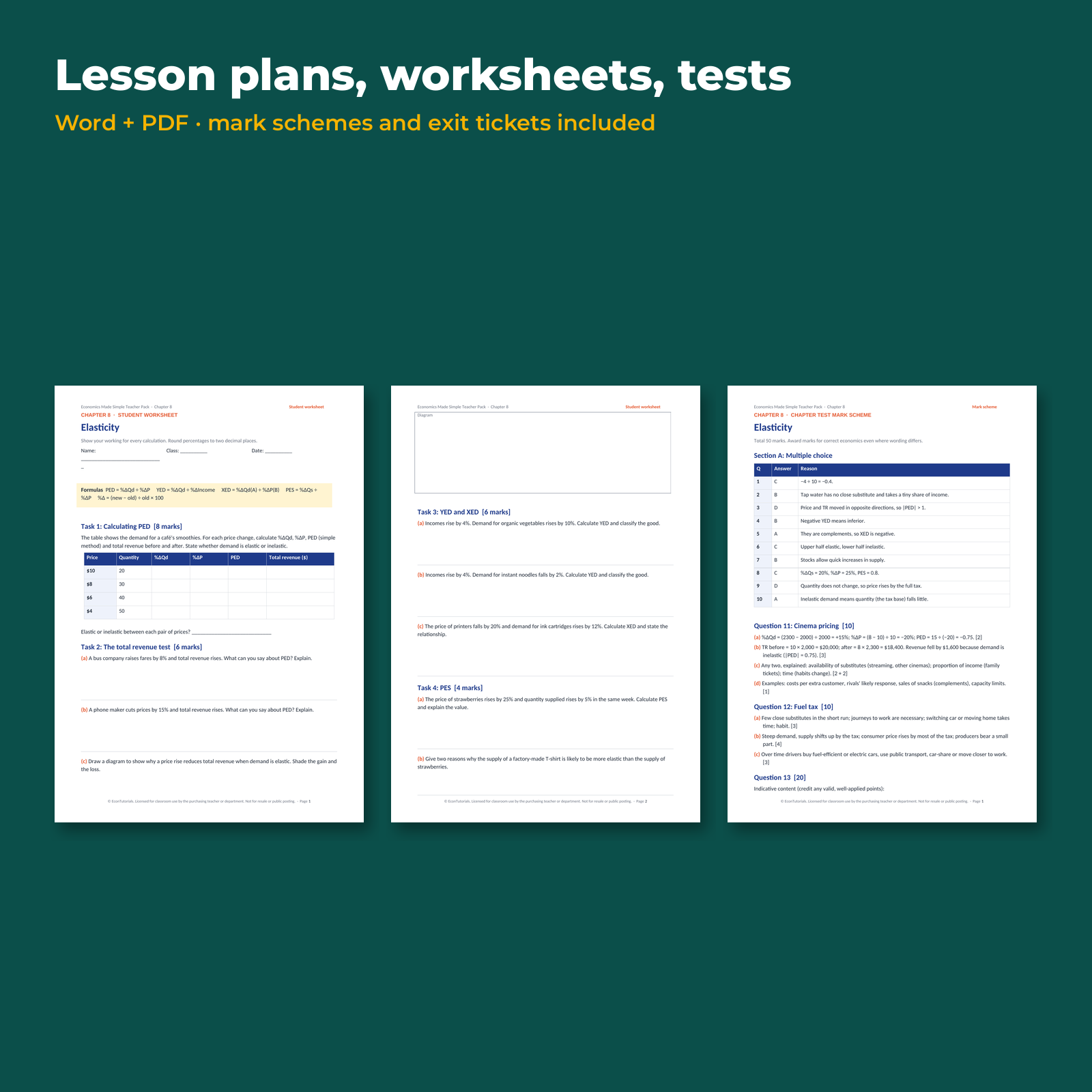
- Lesson plan — two 60-minute lessons, timed minute by minute, with learning objectives, slide references, differentiation for support and stretch, and homework.
- Worksheet and answer key — five or six tasks: calculation, diagram drawing, application, a data-response task built on the case study, and an extension.
- Chapter test and mark scheme — 10 multiple-choice questions, two 10-mark data-response questions and a 20-mark essay with indicative content and level descriptors.
- Exit tickets — three short tickets of three questions each, with answers, for quick checks at the end of a lesson.
Whole-course resources
- Scheme of work — 36 weeks, with the AP, Cambridge 9708 and IB syllabus codes for every chapter.
- Mid-year exam (Chapters 1–16) and end-of-year exam (Chapters 1–30), each with a full mark scheme.
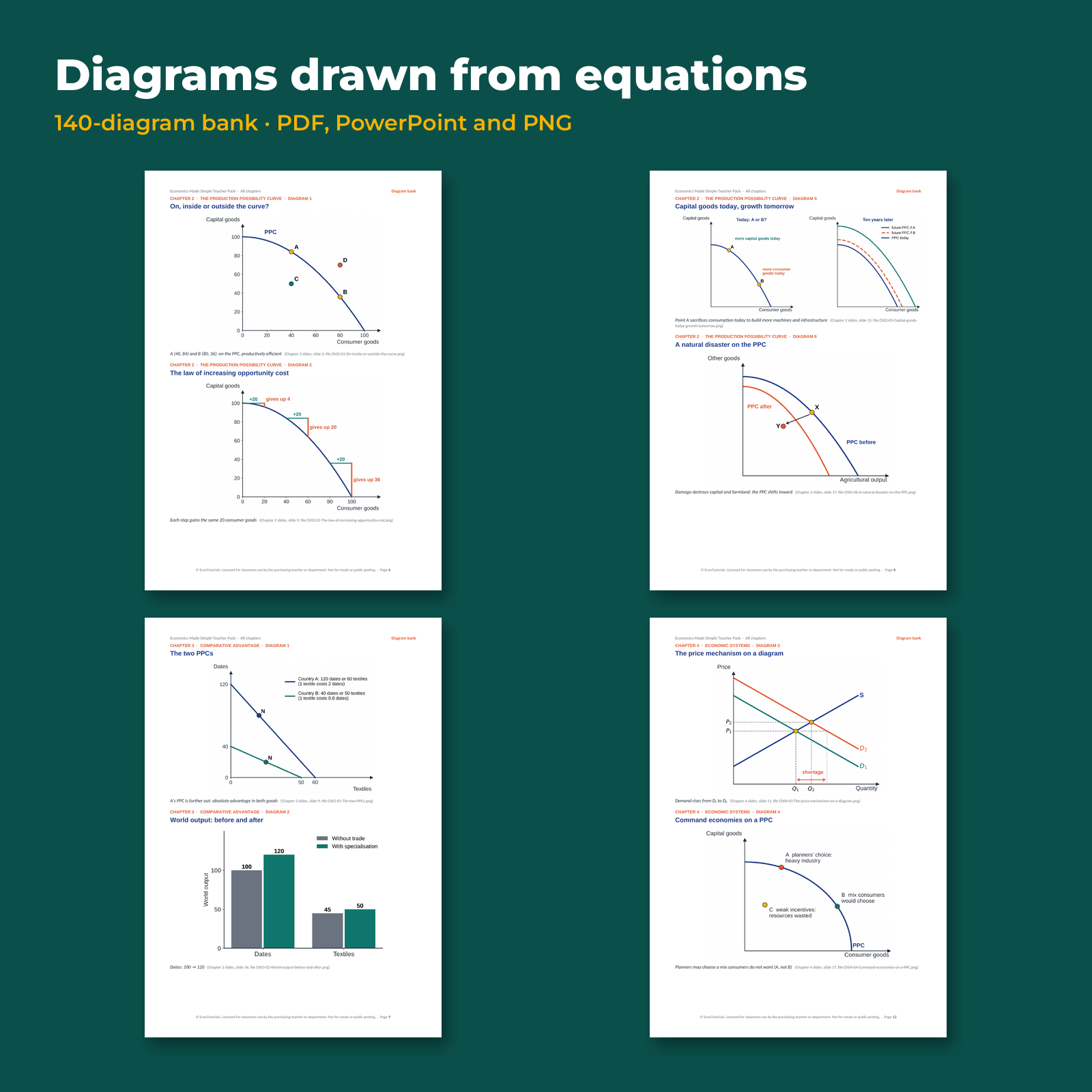
- Diagram bank — all 140 diagrams (demand and supply, elasticity, cost curves, market structures, externalities, AD/AS, the money market, the Phillips curve, exchange rates and more), each drawn from its equations so intersections and shaded areas are exact. Supplied as a PDF, an editable PowerPoint and PNG images for your own resources.
Microeconomics and macroeconomics, chapter by chapter
Chapters 1–18 (micro): the economic problem, the PPC, comparative advantage, economic systems, demand, supply, equilibrium, elasticity, consumer and producer surplus, production and costs, perfect competition, monopoly, monopolistic competition and oligopoly, game theory, labour markets, externalities, public goods and government intervention.
Chapters 19–30 (macro): GDP, unemployment, inflation and price indices, the business cycle and growth, aggregate demand, aggregate supply, macroeconomic equilibrium, money and banking, monetary policy, fiscal policy, the Phillips curve and expectations, and trade, exchange rates and the balance of payments.
Real cases your students will recognise
Each chapter has a factual case study with a citable source, from national statistics agencies, central banks, the IMF, the World Bank and the OECD, chosen to work in classrooms in the Gulf, South Asia, the UK, the US and beyond.
Licence and format
Six ZIP downloads (Start Here and Exams; Chapters 1–10; 11–20; 21–30; Diagram Bank PDF and PowerPoint; Diagram Bank PNGs). Licensed to one teacher or one school department for unlimited classroom use and printing, including a password-protected class page such as Google Classroom. Not for resale or public posting. Download a free sample chapter below before you buy.
Want the student books too? The Teacher Bundle adds the Economics Made Simple textbook and Practice Questions book for $49 (save $28).