
Flip through before you buy
Real sample pages from the book: the contents and the opening of a full chapter.
Economics Made Simple
A Supplementary Guide for AP and Cambridge A Level Students
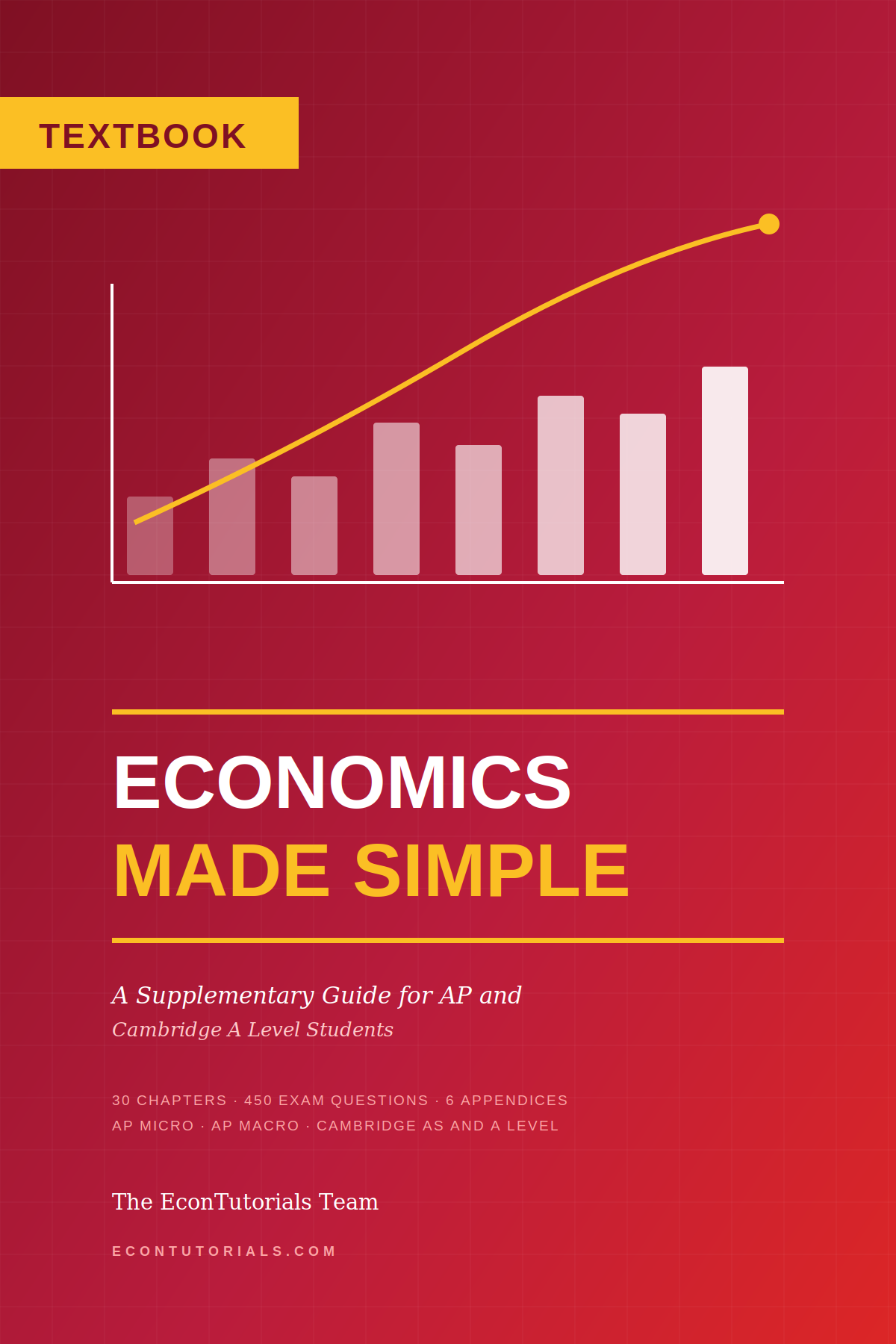
Economics Made Simple: A Supplementary Guide for AP and Cambridge A Level Students
$19
914 pages. 30 chapters. 450 examination questions with complete worked answer keys.
A complete guide to AP Microeconomics, AP Macroeconomics, and Cambridge AS & A Level Economics — written to be argued with, not memorised.
- Every diagram generated from its own equations
- Every numerical answer computed and checked
- 30 real-world case studies with real figures
- 6 appendices: formula sheet, 358-term glossary, exam technique guide
- Fully bookmarked, searchable PDF — reads on any device
Instant digital download. No shipping, no waiting.
Most economics textbooks make one of two mistakes.
What you get
The seven parts
Who it is for
Frequently asked questions
Format & delivery
Most economics textbooks make one of two mistakes.
Either they present the subject as a body of settled results to be memorised — in which case students learn to draw diagrams they do not believe and recite conclusions they cannot defend. Or they present it as a collection of warring schools — in which case students conclude that economists agree on nothing, and that the whole enterprise is politics with equations.
Neither is true, and this book is written on the assumption that a sixteen-year-old can be told so directly.
Economics contains a substantial core on which nearly all economists agree: that opportunity cost is the true measure of cost, that comparative advantage makes trade mutually beneficial, that externalities cause markets to fail, that in the long run output is determined by supply and the price level by demand. It also contains genuine disputes, and the disputes are not decorative. How large is the fiscal multiplier? How fast do economies self-correct? On these, serious people disagree, the evidence is contested, and the answers matter enormously — in 2010 an error about the first of them cost Greece a quarter of its economy.
This book is honest about which is which. Where a result is secure, it is stated plainly. Where it is disputed, both sides are given their strongest form. And where a standard textbook model is known to misdescribe reality — as the money multiplier does — the model is taught, because it is examinable, and then the Bank of England is quoted explaining why it is wrong.
What you get
- 30 chapters across 7 parts — the complete AP Microeconomics, AP Macroeconomics, and Cambridge AS & A Level syllabus, with every chapter opener stating its precise syllabus alignment for AP, Cambridge, and IB.
- 450 examination questions — 180 multiple choice, 90 numerical, 90 short response, and 90 essays — each with a full mark scheme showing exactly what the examiner rewards.
- Around 60 original diagrams, every one generated from its own equations. When a figure shows three curves meeting at a point, they meet there because the algebra puts them there.
- 30 real-world case studies with real figures: Greek unemployment at 27.5%, US inflation peaking at 9.1%, Volcker driving interest rates above 19% and accepting 10.8% unemployment to break it.
- 6 appendices — a complete formula sheet, a 358-term glossary, an examination technique guide, a diagram index with the error to avoid on each one, a case-study data reference, and a curated reading list.
- Fully bookmarked PDF with 39 navigation bookmarks. Jump to any chapter, any appendix, instantly.
The seven parts
- Foundations — scarcity, the production possibility curve, comparative advantage, economic systems
- How Markets Work — demand, supply, equilibrium, elasticity, consumer and producer surplus
- Firms and Markets — production and costs, perfect competition, monopoly, oligopoly, game theory
- Factor Markets and Market Failure — labour markets, externalities, public goods, government intervention
- Measuring the Economy — GDP, unemployment, inflation, the business cycle and economic growth
- Aggregate Demand, Supply, and Policy — the AD/AS model, money and banking, monetary policy, fiscal policy, the Phillips curve
- The Open Economy — trade, exchange rates, the balance of payments
Why the essay questions are different
Every extended-response mark scheme in this book contains the same instruction: a one-sided answer cannot reach the top band.
That is not an examiner's caprice, and it is not padding. An essay that lists three advantages, then three disadvantages, then declares the matter finely balanced, has catalogued the question rather than thought about it.
This book teaches the method that actually earns marks. State your conclusion. State the strongest objection to it — the strongest, in its strongest form, as though you believed it. Answer that objection. Then let your conclusion be changed by whatever you were forced to concede. That is what thinking about a contested question consists of, and it is what the top band is for.
Who it is for
Students sitting AP Microeconomics, AP Macroeconomics, or Cambridge AS and A Level Economics (9708). Also useful for IB Economics SL and HL, and for first-year undergraduates who want a clear treatment of the core.
It assumes no prior economics. It assumes arithmetic, an ability to read a graph, and a willingness to be shown that something you believe is mistaken. No calculus is required.
Format and delivery
PDF. 914 pages. Approximately 15 MB. Fully bookmarked and text-searchable. Reads on laptops, tablets, and phones, and prints cleanly on standard paper.
Instant download after purchase. The link arrives with your order confirmation and never expires. No shipping, no waiting, no physical copy to lose.
A note on honesty
The most important variables in economics — potential output, the natural rate of unemployment, the fiscal multiplier — cannot be observed. They are estimated, and the estimates are revised, sometimes drastically and always in hindsight. In 2007 the IMF believed Spain was running a structural surplus. In 2010 European finance ministries believed the fiscal multiplier was 0.5. Both beliefs were held sincerely by intelligent people, and both were wrong.
Economics is not a body of certainties. It is a discipline for reasoning carefully under uncertainty, and its chief virtue is that it tells you what you would need to know in order to be sure. This book teaches it that way.
Related products
-
Sale!
Complete Bundle — Every Economics and Statistics Book (6 PDFs)
Original price was: $63.$39Current price is: $39. -
Sale!
Economics Case Studies: 100 Real-World Examples with Expert Analysis for Researchers, Teachers and Students
Original price was: $15.$9Current price is: $9. -
Economics Made Simple Free Chapters
$0