
So after studying all of the previous topics which had given preferences and budget constraints, how do consumers choose what to buy?
Consumers choose a combination of goods that will maximize their satisfaction, given the budget available to them.
The maximizing market basket must satisfy two conditions:
- It must be placed on the budget line—>They spend all their income – more is better
- It must give the individual, the highly preferred combination of goods and services.
The consumer optimum, the MRS = price-ratio condition and corner solutions are worked through in the Economics Made Simple Complete Bundle — textbook, practice questions with mark schemes, flashcards and 100 case studies.
Graphically
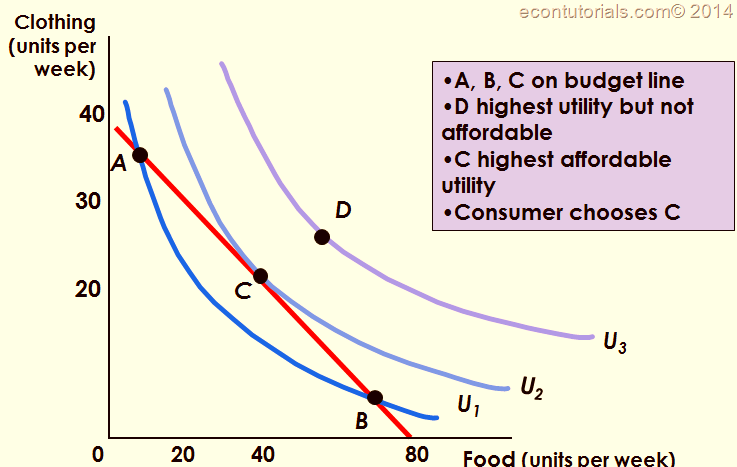 We can see different indifference curves of a consumer choosing between clothing and food. Remember that U3 > U2 > U1 for our indifference curves. Consumer wants to choose highest utility within their budget.
Consumer will choose highest indifference curve on budget line. In the graph above, point C is where the indifference curve is just tangent to the budget line. Slope of the budget line equals the slope of the indifference curve at this point.
Recall, the slope of an indifference curve is:

Further, the slope of the budget line is:

Therefore, it can be said at consumer’s optimal consumption point:

So It can be said that satisfaction is maximized when marginal rate of substitution (of F and C) is equal to the ratio of the prices (of F and C). But also note that this is ONLY true at the optimal consumption point.
Optimal consumption point is where marginal benefits equal marginal costs:
- MB = MRS = benefit associated with consumption of 1 more unit of food
- MC = cost of additional unit of food
- 1 unit food = ½ unit clothing
- PF/PC
If that is not the case than :
- MRS ≠ PF/PC then individuals can reallocate basket to increase utility
If MRS > PF/PC
- Will increase food and decrease clothing until MRS = PF/PC
If MRS < PF/PC
- Will increase clothing and decrease food until MRS = PF/PC.
