
Independent and Dependent Events
Confusing independent and conditional probability is one of the most common exam errors in this subject. The Statistics Made Simple textbook builds this distinction up carefully with a modern, worked-example approach.The events A and B are said to be independent if the occurrence or non-occurrence of event A does not affect the probability of occurrence of B. This means that irrespective whether event A has occurred or not, the probability of B is going to be the same. If the events A and B are not independent, they are said to be dependent.
For example, if we toss two coins, the occurrence and non-occurrence of a head one coin does not in any way effect the occurrence of a head on the other coin. Thus the two coins are independent. Similarly, suppose event A is the drawing of an ace from the pack of 52 cards and event B is throwing a total of a 7 with two dice. The event A and B are independent because drawing of a card does not affect the throwing of a total of 7.
On the other hand, if event A is drawing an ace on the first draw from the pack of cards and event B is drawing an ace on the second draw, it is obvious that the occurrence and non-occurrence of the first event does affect the probability of second event. We say that these two events are not independent; they are dependent events.
In the game of chance, such as tossing a coin or rolling a die, it is always assumed that successive throws are independent events if the coin or the die is fair. It is important to remember that event A is independent of event B when B is independent of A. because of this mutual independence, it is right to say that A and B are independent without specifying which is independent of the other.
Conditional Probability
The probability of the occurrence of an event A when it is known that some other event B has already occurred is called conditional probability of A given that the event B has already occurred and is denoted by P(A I B) is usually as “the probability that A occurs given that B has already occurred” or simply “the probability of A given B”
To illustrate the concept of conditional probability let us consider an example. Suppose a die is rolled. The sample space of this experiment is S = {1,2, 3, 4, 5, 6}. The probability of getting a ‘6’ (event A) is 1/6. i.e. P(A) = 1/6. Suppose we are told that one particular through of a die, the outcome is an even number (event B). B = {2, 4, 6} and the probability of getting a ‘6’ in this reduced sample space is 1/3. This is the conditional probability of occurrence of event A (getting a ‘6’) given that B (getting an even number) has occurred, i.e. P(A I B) = 1/3.
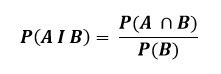
Mathematically, if events A and B belongs to the sample space S and if P(B) ≠ 0, then the conditional probability of A given that B has occurred, denoted by P(A I B), is defined as
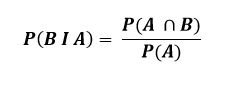
If we interchange the roles of A and B and if P(A) ), then the conditional probability of B given that A has occurred, denoted by P(B I A), is given by
Conditional Probability Example
A fair die is rolled once. Given that the outcome is even , what is the probability of getting a number greater than 3?
Let us first define the following sets:
- S = {1, 2, 3, 4, 5, 6} (sample space)
- A = {2, 4, 6} (set of even numbers)
- B = {4, 5, 6} (set of numbers greater than 3)
- A B = {4, 6} (set of even numbers which are greater than 3)
Since a die is fair, we assign a probability of 1/6 to each sample point. Thus P(A) = 3/6 and P(A B) = 2/6. Using the definition of conditional probability, we can now determine the probability of getting a number greater than 3 given that the outcome is even as
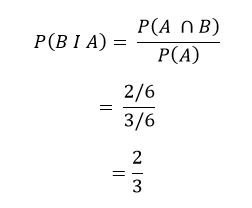
This result can be verified by the fact that out of three even outcomes {2, 4, 6} only two are greater than 3.
To understand the complete topic of probability, read the following lectures below.