
Study smarterInflation causes, costs and policy responses are covered with full AD–AS diagrams and exam technique in the Economics Made Simple Complete Bundle — textbook, practice questions with mark schemes, flashcards and 100 case studies.Introduction...
OUR STUDY MATERIALS FOR YOU !
Check out our latest collection of supplementary books, guides, flashcards, practice questions for Economics, Statistics, Mathematics and many other academic subjects to ace your Cambridge, AP and Undergraduate Exams.
-
Economics Made Simple: A Supplementary Guide for AP and Cambridge A Level Students
$ 19 -
Economics Made Simple Practice Questions
$ 9 -
Printable Flashcards for Economics
$ 5 -
Economics Made Simple Free Chapters
$ 0 -
Sale!
Economics Case Studies: 100 Real-World Examples with Expert Analysis for Researchers, Teachers and Students
Original price was: $ 15.$ 9Current price is: $ 9. -
Sale!
Economics Made Simple Bundle Offer
Original price was: $ 42.$ 29Current price is: $ 29. -
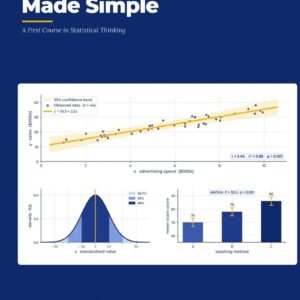
Statistics Made Simple Textbook — A First Course in Statistical Thinking for AP, A-Level, IB and Undergraduate
$ 12 -
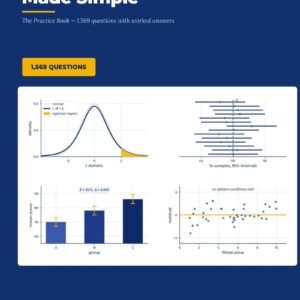
Statistics Made Simple Practice Questions — 1,569 Questions with Fully Worked Answers
$ 9 -
Sale!
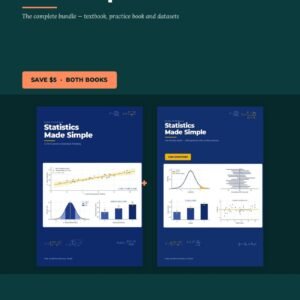
Statistics Made Simple Complete Bundle — Textbook + 1,569 Practice Questions
Original price was: $ 21.$ 16Current price is: $ 16.
Check Our Academic Content
Cracking Economic Indicators: A Beginner’s Guide to Market Signals
In the world of finance and investing, economic indicators play a crucial role in providing valuable insights into the overall health and direction of the economy. These indicators serve as important signals, guiding investors, policymakers, and businesses in making...
Difference between the long-run and short-run Aggregate supply (AS) curve
Introduction The Aggregate Supply (AS) curve shows the total quantity of goods and services that all firms in an economy are willing and able to produce at different price levels. Understanding aggregate supply requires a crucial distinction: the behaviour of the...
Marginal Analysis: Why Every Marginal Concept Is a Derivative
Marginal cost, marginal revenue, marginal utility, marginal product – four names for one piece of mathematics. Why marginal always means derivative, why fixed costs vanish at the margin, why MC cuts AC at its minimum, and why MR = MC is simply the profit derivative set to zero.
t-test vs z-test: Which One Do You Actually Use?
One question decides it: do you know the population standard deviation? If yes, z-test; if you’re estimating it from your sample, t-test — which is almost always. Why the t-distribution has fatter tails, the Guinness brewery origin story, and why “n > 30 use z” is a shortcut, not the rule.
Simpson’s Paradox Explained: When Aggregate Data Lies to You
Treatment A beats Treatment B in every single subgroup of patients — and yet, combine all the subgroups together, and Treatment B wins overall. This isn't a contradiction or a calculation error. It's a real, well-documented phenomenon called Simpson's Paradox, and the...
Ordinary Least Squares (OLS): Derivation, Assumptions, and Why Omitted Variable Bias Ruins Everything
OLS is a covariance-to-variance ratio. Everything else in econometrics is machinery to make one untestable assumption believable. A complete guide: the derivation, the Gauss-Markov assumptions, omitted variable bias, heteroskedasticity, clustering, and the credibility revolution.
Complete EconTutorials Content Library
Welcome to the EconTutorials Content LibraryEverything published on EconTutorials — in one place, organised by subject. Whether you're studying for AP Economics, Cambridge A-Level, IB, or undergraduate exams, use this page to find exactly what you need.🛒...
Difference between Perfect and Imperfect multicollinearity
Study smarterMulticollinearity, VIF diagnostics and the rest of the classical regression assumptions are covered in the Statistics Made Simple Complete Bundle — textbook plus 1,569 practice questions with worked answers, 18 datasets and R and Stata...
Recommendations
Economics Made Simple — The Complete Bundle
The Complete Bundle brings together everything we have built for AP and Cambridge A-Level Economics students: the full 914-page supplementary textbook, a 450-question practice workbook with mark schemes, a rapid-revision flashcard deck, and 100 real-world case studies with expert analysis. Four products, one price — designed to take you from first principles to exam-ready.
Most students use the textbook to understand the theory, the practice questions to test themselves under timed conditions, and the flashcards in the final week before the exam. The case studies sit alongside both — every concept grounded in something that actually happened, from carbon pricing in Sweden to the 2008 financial crisis. It is the study system we wish we had when we were students.

Be Apart of the Academic Community
Join the community of learner and receive free chapters, case studies and supplementary materials to ace in your exams.