
Study smarterGrowth-rate calculations, compounding and the difference between nominal and real growth are worked through step by step in the Economics Made Simple Complete Bundle — textbook, practice questions with mark schemes, flashcards and 100 case...
OUR STUDY MATERIALS FOR YOU !
Check out our latest collection of supplementary books, guides, flashcards, practice questions for Economics, Statistics, Mathematics and many other academic subjects to ace your Cambridge, AP and Undergraduate Exams.
-
Economics Made Simple: A Supplementary Guide for AP and Cambridge A Level Students
$ 19 -
Economics Made Simple Practice Questions
$ 9 -
Printable Flashcards for Economics
$ 5 -
Economics Made Simple Free Chapters
$ 0 -
Sale!
Economics Case Studies: 100 Real-World Examples with Expert Analysis for Researchers, Teachers and Students
Original price was: $ 15.$ 9Current price is: $ 9. -
Sale!
Economics Made Simple Bundle Offer
Original price was: $ 42.$ 29Current price is: $ 29. -
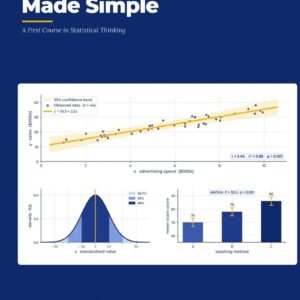
Statistics Made Simple Textbook — A First Course in Statistical Thinking for AP, A-Level, IB and Undergraduate
$ 12 -
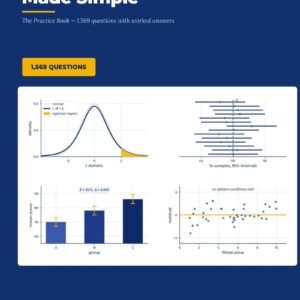
Statistics Made Simple Practice Questions — 1,569 Questions with Fully Worked Answers
$ 9 -
Sale!
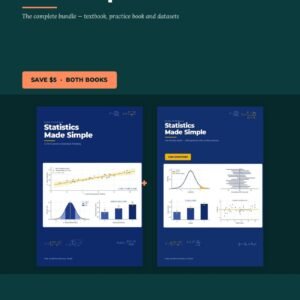
Statistics Made Simple Complete Bundle — Textbook + 1,569 Practice Questions
Original price was: $ 21.$ 16Current price is: $ 16.
Check Our Academic Content
Nominal GDP, Real GDP and the GDP Deflator: Formulas, Worked Examples and Index-Number Bias
An economy that produces nothing new but doubles every price reports 100% nominal GDP growth. A complete guide to nominal GDP, real GDP and the GDP deflator — with worked calculations, why the deflator excludes imports, base-year bias, chain weighting, and Nordhaus on the price of light.
Difference between GDP and GNP
Although both GDP and GNP measure the size of an economy, either for business or economics forecasting purposes, they are not one and the same thing. Therefore, one should not be confused by their similar terminology. Simply put, while GDP looks at the strength of a...
Central Limit Theorem Explained: Why It’s the Foundation of Statistics
The CLT is the engine behind every confidence interval and t-test you'll ever run, and it's one of the most tested concepts across AP, A-Level and undergraduate exams. The Statistics Made Simple Practice Questions workbook has a dedicated chapter of CLT and...
Matrix Algebra for Economists: Operations, Determinants, Cramer’s Rule and Leontief Input-Output Analysis
An economy is a web of industries feeding into one another. Wassily Leontief won a Nobel Prize turning that tangle into a grid you can solve all at once. A complete guide to matrix algebra for economists: operations, the determinant, the inverse, Cramer’s Rule, and the Leontief input-output model — with worked examples, real applications, and exam technique.
Elasticity Mathematics: Point vs Arc Elasticity, Cross-Price Elasticity and the Lerner Index
Elasticity is a precise number with a precise formula — and which formula you use changes the answer. A complete guide to the mathematics of elasticity: the arc (midpoint) method, point elasticity with calculus, why linear demand has changing elasticity, the revenue rule, income and cross-price elasticity, and the Lerner Index as a measure of monopoly power — with worked examples and exam technique.
No Results Found
The page you requested could not be found. Try refining your search, or use the navigation above to locate the post.
Recommendations
Economics Made Simple — The Complete Bundle
The Complete Bundle brings together everything we have built for AP and Cambridge A-Level Economics students: the full 914-page supplementary textbook, a 450-question practice workbook with mark schemes, a rapid-revision flashcard deck, and 100 real-world case studies with expert analysis. Four products, one price — designed to take you from first principles to exam-ready.
Most students use the textbook to understand the theory, the practice questions to test themselves under timed conditions, and the flashcards in the final week before the exam. The case studies sit alongside both — every concept grounded in something that actually happened, from carbon pricing in Sweden to the 2008 financial crisis. It is the study system we wish we had when we were students.

Be Apart of the Academic Community
Join the community of learner and receive free chapters, case studies and supplementary materials to ace in your exams.