
GDP is considered to be the most simplest and common economic statistics that measures the economic activity of the economy that takes place within a year - that leads to the analysis and conditions of various factors such as investments, household consumption ,...
OUR STUDY MATERIALS FOR YOU !
Check out our latest collection of supplementary books, guides, flashcards, practice questions for Economics, Statistics, Mathematics and many other academic subjects to ace your Cambridge, AP and Undergraduate Exams.
-
Economics Made Simple: A Supplementary Guide for AP and Cambridge A Level Students
$ 19 -
Economics Made Simple Practice Questions
$ 9 -
Printable Flashcards for Economics
$ 5 -
Economics Made Simple Free Chapters
$ 0 -
Sale!
Economics Case Studies: 100 Real-World Examples with Expert Analysis for Researchers, Teachers and Students
Original price was: $ 15.$ 9Current price is: $ 9. -
Sale!
Economics Made Simple Bundle Offer
Original price was: $ 42.$ 29Current price is: $ 29. -
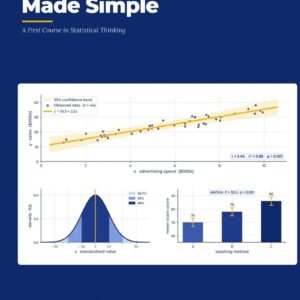
Statistics Made Simple Textbook — A First Course in Statistical Thinking for AP, A-Level, IB and Undergraduate
$ 12 -
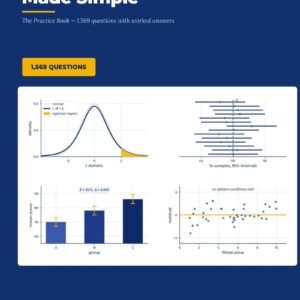
Statistics Made Simple Practice Questions — 1,569 Questions with Fully Worked Answers
$ 9 -
Sale!
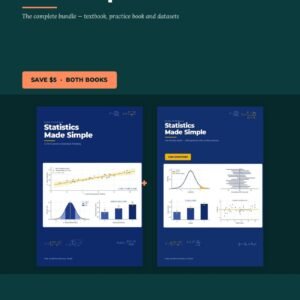
Statistics Made Simple Complete Bundle — Textbook + 1,569 Practice Questions
Original price was: $ 21.$ 16Current price is: $ 16.
Check Our Academic Content
Difference between aggregate supply and market supply curve
By definition, the Aggregate Supply curve shows the relationship between the Aggregate Quantity Supplied by all the businesses and firms of an economy and the over price level. Study smarterAggregate supply, market structures and the whole AD-AS framework are...
What is Money ?
To explain it with a formal definition Money is : Anything that is accepted as a way of exchange to buy products and services The basics mechanics of the whole monetray system are invisible. Many individuals take money for granted when they are spending it. So when...
One-Way ANOVA Explained: Comparing Means Across Multiple Groups
You already know how to compare two means with a t-test. But what happens when you need to compare three, four, or ten groups at once? Running t-tests on every pair inflates your error rate fast — and ANOVA is the tool built to solve that exact problem. The...
Sampling Methods in Statistics: Random, Stratified, Systematic and Cluster
The most sophisticated statistical test in the world is worthless if the sample it's built on is biased. Before any confidence interval or hypothesis test matters, the sampling method has to be right — and this is one of the most exam-tested, most misunderstood...
Chi-Square Test Explained: Goodness of Fit and Test of Independence
Every t-test and z-test you've met so far compares means of numeric data. But what happens when your data is categorical — brand preferences, survey responses, pass/fail outcomes? The chi-square test is the tool built for exactly that gap, and it appears...
No Results Found
The page you requested could not be found. Try refining your search, or use the navigation above to locate the post.
Recommendations
Economics Made Simple — The Complete Bundle
The Complete Bundle brings together everything we have built for AP and Cambridge A-Level Economics students: the full 914-page supplementary textbook, a 450-question practice workbook with mark schemes, a rapid-revision flashcard deck, and 100 real-world case studies with expert analysis. Four products, one price — designed to take you from first principles to exam-ready.
Most students use the textbook to understand the theory, the practice questions to test themselves under timed conditions, and the flashcards in the final week before the exam. The case studies sit alongside both — every concept grounded in something that actually happened, from carbon pricing in Sweden to the 2008 financial crisis. It is the study system we wish we had when we were students.

Be Apart of the Academic Community
Join the community of learner and receive free chapters, case studies and supplementary materials to ace in your exams.