
Three completely different accounting routes — production, expenditure, and income — must arrive at exactly the same number. A complete guide to calculating GDP, with the value-added identity, the C+I+G+(X−M) formula, Ireland’s 26% growth year, Nigeria’s rebasing, and Kuznets’s original warning.
OUR STUDY MATERIALS FOR YOU !
Check out our latest collection of supplementary books, guides, flashcards, practice questions for Economics, Statistics, Mathematics and many other academic subjects to ace your Cambridge, AP and Undergraduate Exams.
-
Economics Made Simple: A Supplementary Guide for AP and Cambridge A Level Students
$ 19 -
Economics Made Simple Practice Questions
$ 9 -
Printable Flashcards for Economics
$ 5 -
Economics Made Simple Free Chapters
$ 0 -
Sale!
Economics Case Studies: 100 Real-World Examples with Expert Analysis for Researchers, Teachers and Students
Original price was: $ 15.$ 9Current price is: $ 9. -
Sale!
Economics Made Simple Bundle Offer
Original price was: $ 42.$ 29Current price is: $ 29. -
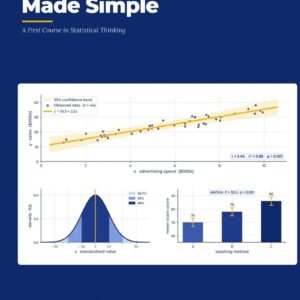
Statistics Made Simple Textbook — A First Course in Statistical Thinking for AP, A-Level, IB and Undergraduate
$ 12 -
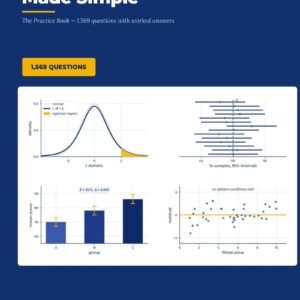
Statistics Made Simple Practice Questions — 1,569 Questions with Fully Worked Answers
$ 9 -
Sale!
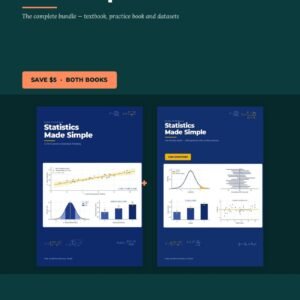
Statistics Made Simple Complete Bundle — Textbook + 1,569 Practice Questions
Original price was: $ 21.$ 16Current price is: $ 16.
Check Our Academic Content
GDP Introduction and Usage
Study smarterGDP, its three measurement approaches and Kuznets’s warning about using it as a welfare measure are covered in full in the Economics Made Simple Complete Bundle — textbook, practice questions with mark schemes, flashcards and 100 case...
Unemployment Rate: Definition, Measurement, Okun’s Law and Why the Statistic Misleads
A person who stops looking for work isn’t unemployed — they vanish from the statistic, and the rate falls. A complete guide to measuring unemployment: the ILO criteria, U-3 vs U-6, the four types, Okun’s Law, the Beveridge curve, and why Blanchard and Summers showed the natural rate isn’t natural.
Correlation vs Causation: Key Differences, Examples and Why It Matters
Distinguishing correlation from causation is a skill examiners test constantly, and it only sharpens with repetition. The Statistics Made Simple Practice Questions workbook has scenario-based questions with full mark schemes for exactly this kind of critical...
Nash Equilibrium Explained: Definition, Examples and Real-World Applications
Game Theory · Nash EquilibriumNash Equilibrium ExplainedThe single most important concept in game theory — what happens when every player is doing the best they can given what everyone else is doing.In 1950, a 22-year-old PhD student at Princeton submitted a 27-page...
Type I and Type II Errors in Statistics: Clear Explanation with Examples
Recognising Type I vs Type II scenarios quickly is a skill built through repetition, not memorisation. The Statistics Made Simple Practice Questions workbook drills this with exam-style questions and full mark schemes. Statistics · Hypothesis Testing Type I and Type...
No Results Found
The page you requested could not be found. Try refining your search, or use the navigation above to locate the post.
Recommendations
Economics Made Simple — The Complete Bundle
The Complete Bundle brings together everything we have built for AP and Cambridge A-Level Economics students: the full 914-page supplementary textbook, a 450-question practice workbook with mark schemes, a rapid-revision flashcard deck, and 100 real-world case studies with expert analysis. Four products, one price — designed to take you from first principles to exam-ready.
Most students use the textbook to understand the theory, the practice questions to test themselves under timed conditions, and the flashcards in the final week before the exam. The case studies sit alongside both — every concept grounded in something that actually happened, from carbon pricing in Sweden to the 2008 financial crisis. It is the study system we wish we had when we were students.

Be Apart of the Academic Community
Join the community of learner and receive free chapters, case studies and supplementary materials to ace in your exams.