
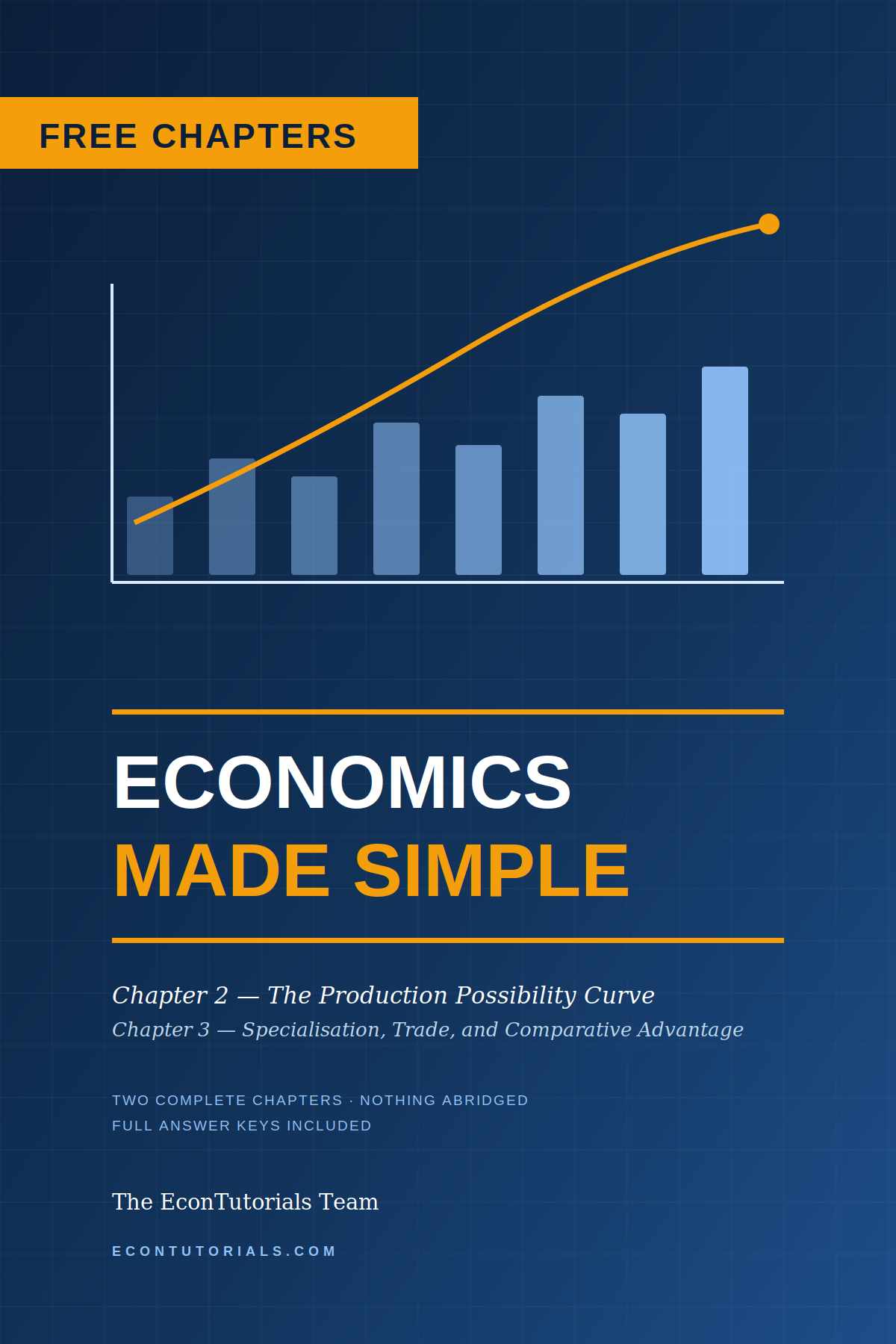
Economics Made Simple Free Chapters
Two complete chapters from Economics Made Simple — free, no strings attached.
- Chapter 2: The Production Possibility Curve — scarcity, opportunity cost, economic growth, and the Germany 2022 energy shock case study
- Chapter 3: Comparative Advantage — absolute vs comparative advantage, specialisation, terms of trade, and the Bangladesh trade case study
- 15 exam-style practice questions per chapter with full worked answer keys
- Covers AP Economics and Cambridge A Level (9708) syllabus alignment
- Instant PDF download. No account required.
$ 0
Product Details
Before you buy, read.
These are two complete, unedited chapters from Economics Made Simple: A Supplementary Guide for AP and Cambridge A Level Students — the same formatting, the same diagrams, the same exam questions, the same worked answers. Nothing is simplified or held back for the paid version.
If these chapters work for you, the full 30-chapter book will too.
Chapter 2: The Production Possibility Curve
The production possibility curve is the first real model in economics — and one of the most misunderstood. Most students learn to draw it without understanding why it is concave, what a point inside it actually means, or why a country can experience growth without any new resources being discovered.
This chapter covers all of it: opportunity cost on the PPC, the difference between a linear and a concave frontier and what each assumes about resources, movements along the curve vs. shifts, and what economic growth actually looks like in the model. The Germany 2022 energy shock case study shows a real economy moving inward on its frontier — what caused it, by how much, and what policy options were available.
Topics covered: scarcity and choice, opportunity cost, the PPC model, productive and allocative efficiency, economic growth (supply-side vs demand-side), the effect of war, sanctions, and resource shocks.
Chapter 3: Comparative Advantage
Comparative advantage is one of the most counterintuitive results in all of economics. It says that even if one country is absolutely better at producing everything, both countries still gain from trading with each other. Most students accept this on faith. This chapter proves it, works through the arithmetic, and shows where the argument breaks down in practice.
The Bangladesh garment industry case study works through a real example: how a country with lower productivity in every sector nonetheless became the world’s second-largest garment exporter, what comparative advantage predicts about this, and what it gets wrong.
Topics covered: absolute advantage vs comparative advantage, opportunity cost ratios, the terms of trade, gains from specialisation, limitations of the model (factor immobility, infant industries, strategic trade policy).
What each chapter includes
Both chapters follow the full Economics Made Simple format — the same structure used across all 30 chapters of the book:
- Syllabus alignment table (AP Micro/Macro and Cambridge 9708)
- Key term definitions written to match exam marking language
- Original diagrams generated from equations, not hand-drawn estimates
- Real-world case study with actual data
- 15 exam-style practice questions (multiple choice, numerical, short response, and essay)
- Complete worked answer key with mark-scheme guidance
Format and delivery
PDF. Two chapters, approximately 60 pages total. Instant download — the link arrives immediately with your order confirmation. No account required, no email list, no follow-up.
If you want the rest of the book after reading these, the full 30-chapter edition is available in the store
Related products
-
Printable Flashcards for Economics
$ 5 -
Sale!
Economics Case Studies: 100 Real-World Examples with Expert Analysis for Researchers, Teachers and Students
Original price was: $ 15.$ 9Current price is: $ 9. -
Economics Made Simple Practice Questions
$ 9 -
Sale!
Economics Made Simple Bundle Offer
Original price was: $ 42.$ 29Current price is: $ 29.