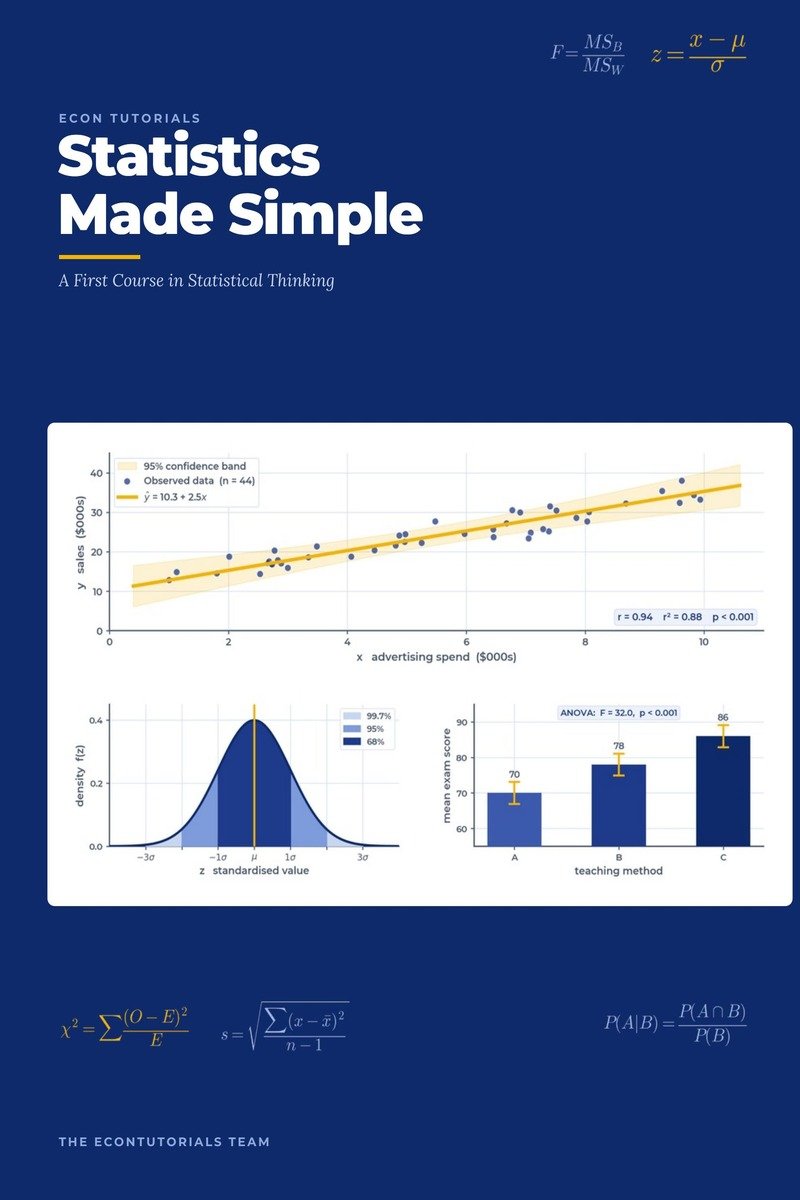
Statistics Made Simple Textbook — A First Course in Statistical Thinking for AP, A-Level, IB and Undergraduate
A complete statistics textbook that teaches the reasoning, not just the formulas. 246 pages and 16 chapters, from describing data through probability to regression — with every calculation worked by hand.
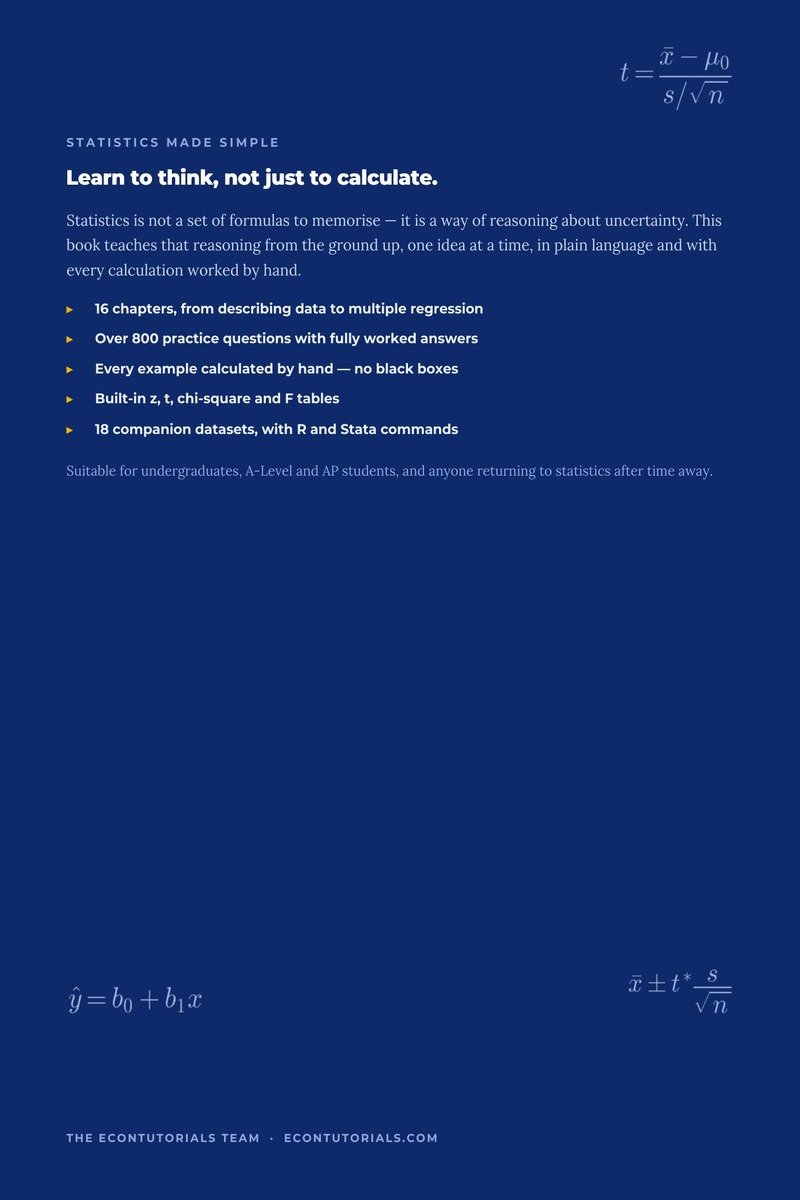
- ✓ 16 chapters: descriptive statistics, probability, distributions, confidence intervals, hypothesis testing, chi-square, ANOVA and regression
- ✓ Over 800 practice questions with fully worked answer keys
- ✓ Built-in z, t, chi-square and F tables — no separate formula booklet needed
- ✓ 18 companion datasets plus an R and Stata appendix with verified output
- ✓ Written for AP Statistics, Cambridge A-Level, IB and undergraduate courses
- ✓ Instant PDF download — no subscription, yours to keep forever
$ 12
Product Details
Most students meet statistics as a list of formulas to memorise and a set of buttons to press. This statistics textbook takes the opposite approach: it teaches statistics as a way of reasoning about uncertainty, introducing each idea one at a time, in plain language, with every calculation worked out by hand.
That last point matters more than it sounds. Statistical software will always compute faster than you can. Knowing what it is doing internally is what lets you spot a wrong answer, a failed assumption, or a meaningless p-value. Statistics Made Simple teaches the arithmetic first, then shows you the software.
What this statistics textbook covers
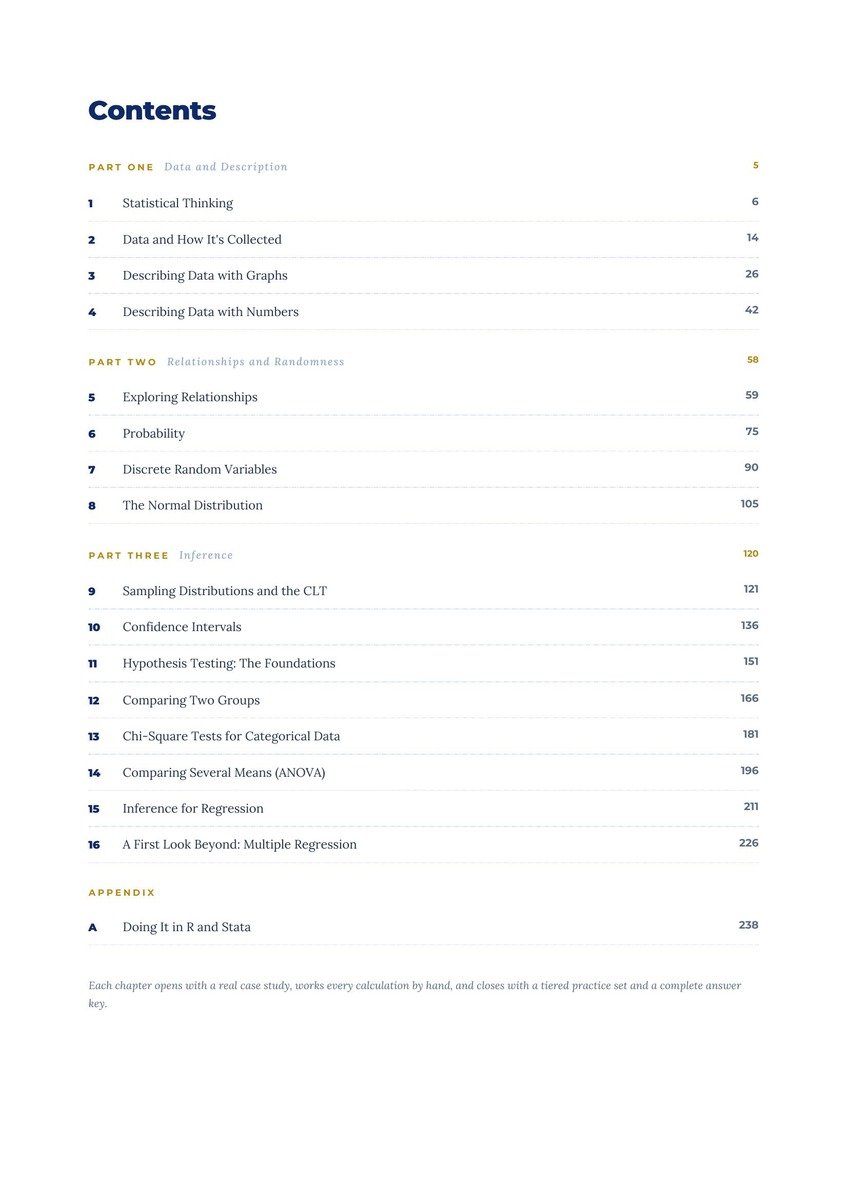
- Part One — Data and Description (Chapters 1–4). What statistics really is, sampling methods and bias, types of variables and levels of measurement, frequency tables, histograms, boxplots, mean, median, standard deviation, z-scores and outliers — plus how graphs mislead.
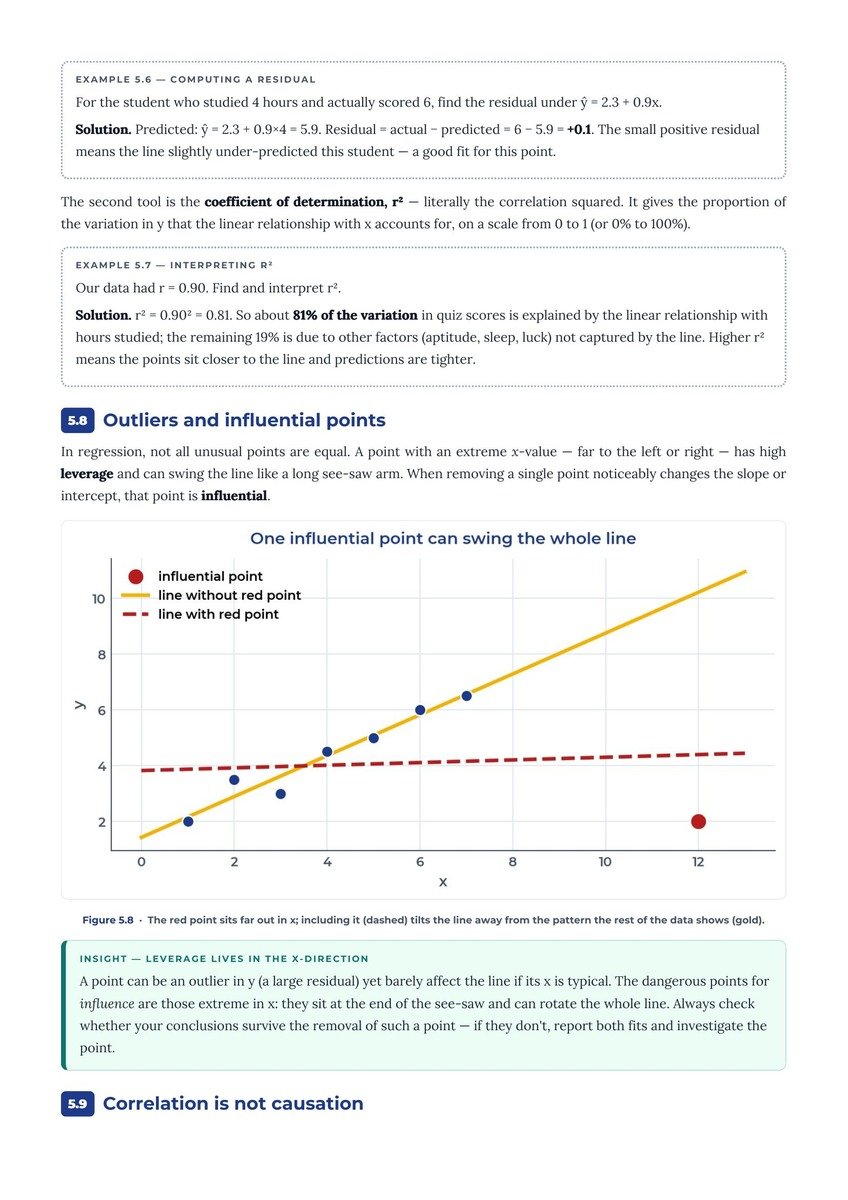
- Part Two — Relationships and Randomness (Chapters 5–8). Scatterplots, correlation and least-squares regression, correlation versus causation, probability rules, conditional probability and Bayes-style reasoning, discrete random variables, the binomial and Poisson distributions, and the normal distribution.
- Part Three — Inference (Chapters 9–16). Sampling distributions and the Central Limit Theorem, confidence intervals, hypothesis testing and p-values, Type I and Type II errors, comparing two groups with paired and independent t-tests, chi-square tests, ANOVA, inference for regression, and a capstone chapter on multiple regression.
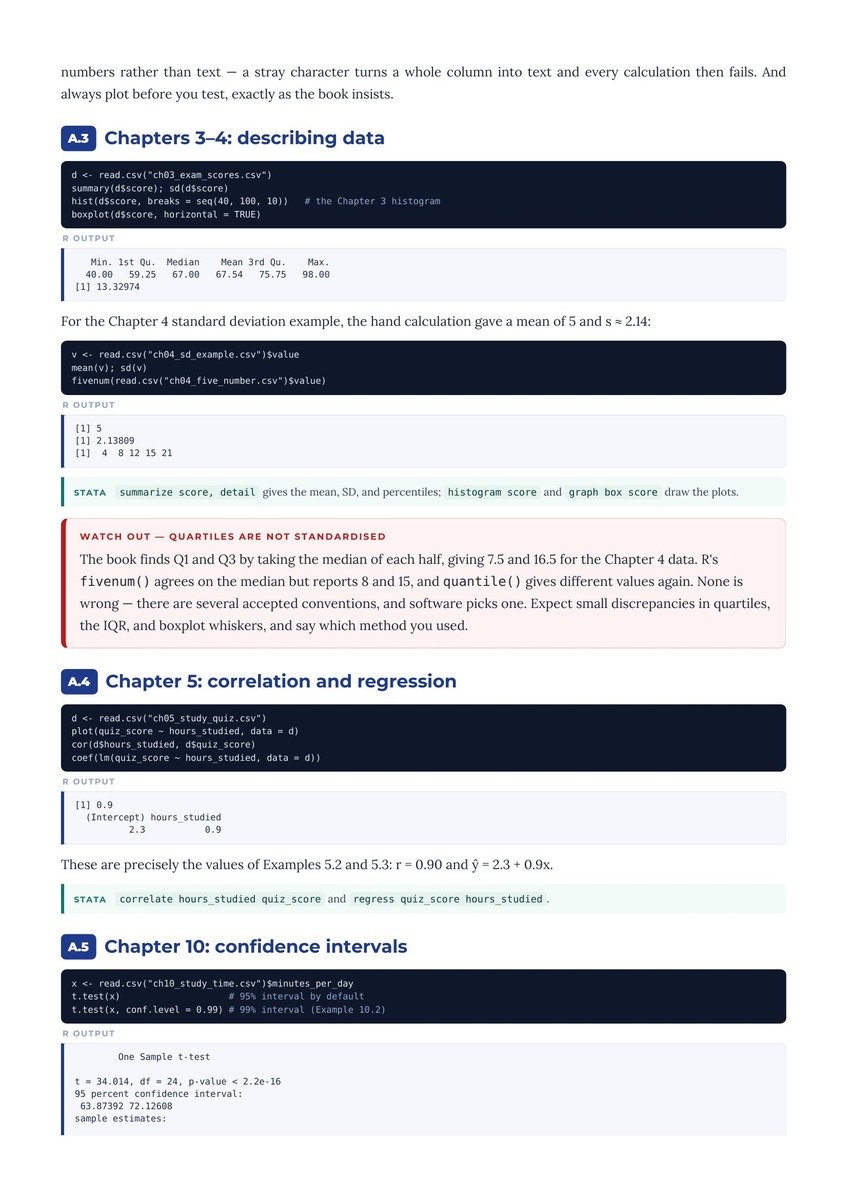
- Appendix A — Doing It in R and Stata. Chapter-by-chapter commands with genuine, verified output, plus a guide to the cases where hand calculations and software legitimately disagree.
How every chapter works
Each chapter opens with a real case study — a medical screening test that misleads doctors, an A/B test stopped too early, a study whose conclusion reverses when a single variable is added. The statistics is then developed to solve that opening problem, so you always know why a technique exists before you learn how to use it.
Throughout you get Key Term boxes for definitions, Insight boxes for the ideas that unlock a topic, and Common Error boxes for the mistakes that cost marks in exams. Every chapter ends with a tiered practice set and a complete answer key that shows the working, not just the final number.
Statistical tables included
The z table, t table, chi-square table and F table are printed inside the chapters that use them. You never need a separate statistics formula booklet or a second browser tab open while you work.
18 companion datasets for R, Stata, Excel and Python
Every worked example built on real data comes with a CSV file, so you can reproduce each result yourself. All of the R output shown in Appendix A was generated by running the commands on these exact files, so what you see in the book is what you will see on your screen.
Who this statistics book is for
Written for students taking AP Statistics, Cambridge A-Level Statistics, IB Mathematics, or a first undergraduate course in statistics, psychology, business or econometrics — and for anyone returning to statistics after time away. No prior statistics knowledge is assumed, and the mathematics never goes beyond ordinary algebra.
What you get
- The complete 246-page statistics textbook as a PDF, bookmarked by chapter for fast navigation
- The R and Stata appendix as a separate PDF
- A Reader Pack containing 18 companion datasets as CSV files, plus every chapter as a standalone PDF so you can read or print one topic at a time
Instant download after checkout. No account and no subscription required, and the files are yours to keep permanently.
Looking for more practice? The companion practice book — with 1,569 questions and full worked solutions — is coming soon.